
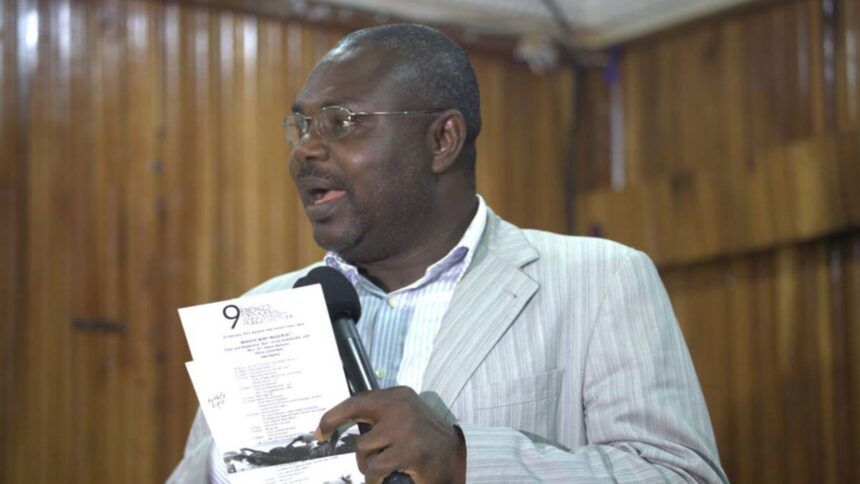

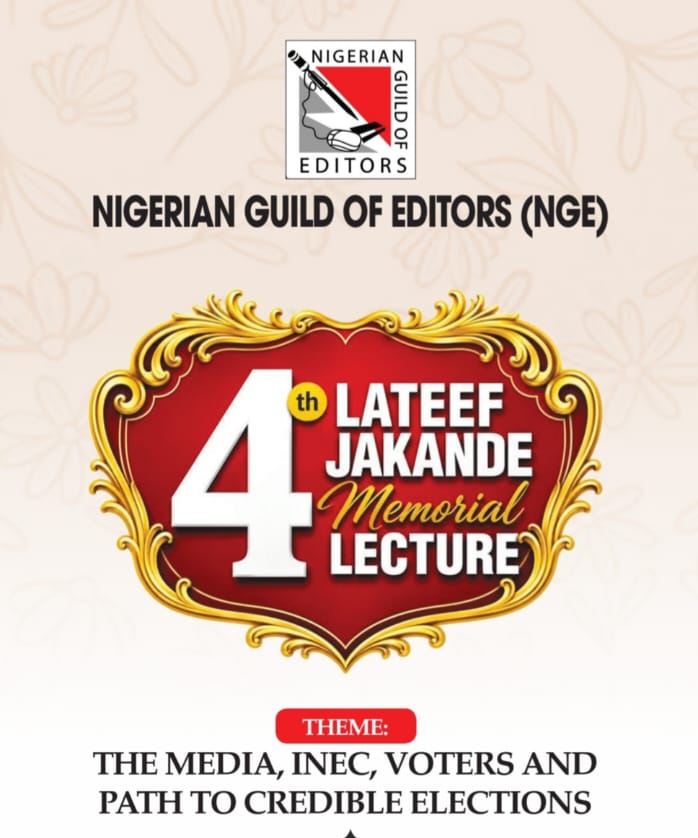
Being keynote address delivered by PROFESSOR SYLVESTER ODION AKHAINE at the Fourth Annual Lateef Kayode Jakande Lecture, organised by the Nigerian Guild of Editors at Sheraton Hotel, Ikeja, Lagos Nigeria, on 23rd of July, 2026.
Preamble
I want to thank the Nigerian Guild of Editors (NGE) for inviting me to deliver this year’s Jakande memorial lecture, the fourth in the series. Indeed, I consider it a great honour. The Jakande years, that is the second republic, has always been of comparative value to me in analysing the prevailing contradictions of the fourth republic. Its hindsight benefit is that those years affirmed the slogans of the social action movement: “Another Nigeria is Possible”. The theme of this lecture, namely, Media, INEC, Voters and Path to Credible Elections is appropriate for three reasons. First, the lecture is coming up in the buildup to the 2027 general elections. It is hardly surprising that the theme has three independent variables and one dependent variable. For credible elections to take place in our country, the media, INEC, and voters have a role to play. Two, the lie of the state. The Nigerian state is emasculated, a pathology that scholars (Bayart, 1993, Onuoha, 2008) have theorised as ‘state capture’. It manifests when the components elements of the state lose their relative autonomy in ways that the state could be considered as an impartial umpire in the social relations of production. The executive arm of government rides roughshod over the other arms of government blurring the imagined borders, in other words, checkpoints, contemplated by de Montesquieu. Side-by-side with state-capture is the point that the state suffers negative sovereignty for the reason that a swathe of the country is being controlled by non-state actors. The gravity is such that it has engendered a security dilemma in the country to the extent that the constitutionally created securities agencies are now being complemented by local vigilantes. Three, our political culture is highly impoverished. The beliefs, values, sentiments and practices that permeate our political system are concerning. The elite recruitment process shuns merits, enthrones mediocrity and is simultaneously monetised in ways that lead to elite closure. Also, there is huge trust deficit and a prevailing sense of being subject, one of Almond and Powell’s (1978) three-fold typology where citizens see themselves not only as non-participants in the political process but rather as subjects of the government. O’Donnell (1993) has qualified citizens in that scenario as one of low intensity. These backdrops would shape our conversation. And the context of this conversation is liberal democracy which the Nigerian ruling elite chose in 1999 and had previously practiced in the previous republics. Liberal democracy is a Lockean contrivance embodying a cluster of freedoms including political freedoms, right to property and enjoyment of security (Locke, 1988[1690]). According to Potter (1997, p. 4), liberal democracy is:
a type of political regime in which binding rules and policy decisions are made not by the entire community but by representatives accountable to the community. This accountability is secured primarily through free, fair and competitive elections in which virtually all adult men and women have the right to vote and stand for elective office.
I now turn the variables in our conversation.
Defining the Variables: Media, INEC, Voters and Credible Elections
Defining what media is in the midst of practitioners would appear unnecessary. For reason of reiteration and the existence of pluralism of meaning in scholarship, I will offer a working definition. Thus, media is a Latin derivative from the word “medius”, which means “middle” or “intermediate”. It can be defined as the conduits for disseminating information to the public for various purposes, namely, information, education, entertainment and shaping of public opinion (Amirize, 2004).They include newspapers, magazines, books, radio, television, cinema, internet, social media, mobile phones, etc (O.P. Jindal Global University, 2024). The conduits and the corresponding practice and the embedded dynamics, make media an institution.
I shall employ both media and press interchangeably in this lecture fully aware of the nuances between the two but in a constricted sense of their convergence at the intersection of journalism-focused institutions such as print, broadcast, and digital newsrooms. Historically, the development of the printing press in the 15th century revolutionised the media. To date, the media has continued to shape our daily conversation. In ways, relevant to this paper, Downing (1980, p. 145) provides a political origin of the media, rooted in societal class conflict:
The changing structure of public debate was of course a parallel to the growing demand by the well-to-do for freedom from government interference in their economic activity. Just as market forces should be allowed tom work themselves out freely, ran the arguments, so should ideas about politics and government. It was a tenacious ideology, which took the ideas of the well-to-do and the politically dominant as expressing the interest of the majority. This emerging structure of public debate was the matrix for the development of the newspaper. It was not the advances in printing technology that causes the newspaper, but changes in certain economic and political relations which stimulated the need for news-sheet and newspaper to convey information quickly about politics and other matters to a large number of people.
Curran (2002, p. 4) reinforces Downing perspective in his historicisation of the British Media. He observes that:
The liberal narrative is the oldest and best established of the competing interpretations of British media history. It comes out of an historical tradition which celebrates the evolution of ‘constitutional government’ by recording the rise of parliament, the establishment of the rule of law, the erosion of monarchical power, the development of modern political parties and—in the final culmination of this teleological history—the introduction of mass democracy.
Historically, the media had evolved into the fourth estate of the realm. The Nigerian media, predating the Nigerian state, has had a libertarian bent. The principle of freedom drove much of its engagement with the colonial order.
The Independent National Electoral Commission (INEC)
The INEC is Nigeria’s electoral management body (EMB). Electoral management bodies (EMBs) are generally responsible for the management of elections, either entirely or partly. Elections management embraces the organization of elections, its monitoring, and the official recognition of election results (Mozaffar, & Shedler, 2002, cited in Langford et al, 2012). Mozzafar and Shedler (2002, cited in Langford et al 2012) go further to describe their roles employing Almond and Powell (1966)) three-fold typology of rulemaking, rule application, and rule adjudication. EMBs are constitutionalised in the organic laws of countries. The end of bipolarity and the celebrated triumph of liberal internationalism birthed the third wave of democratisation (Akhaine, 2010) and the subsequent proliferation of EMBs. In democratising social formations, legitimate elections are central to stabilising the polity and norms institutionalisation.
As Langford et al (2022) has noted:
Following the third wave of democratization, the number of EMBs has expanded dramatically, especially in the democratizing regions of Latin America and the Caribbean, Sub-Saharan Africa, and South Asia – although with mixed patterns in both South-East Asia and East Asia.
As of 2013, about 54 percent of states had consequential provisions for electoral oversight provided for in their organic laws. There has been an upsurge since the beginning of the third wave (Zachary et al 2024, cited in Langford et al, 2012).
It can be observed today that in Africa, the third wave is suffering from democratic backsliding and most EMBs do not have the autonomy required for conducting legitimate elections.
Electoral management in Nigeria has had a checkered history. The Electoral Commission of Nigeria (ECN) was established to conduct the 1959 elections. This was succeeded by the post-independence Federal Electoral Commission (FEC) in 1960 which conducted the federal and western regional elections of 1964 and 1965 respectively. Following military rule, existing democratic structures were proscribed by the military. Military’s transition politics meant the resuscitation of democratic institutions, and hence the establishment of the Federal Electoral Commission (FEDECO) in 1978 that organised the 1979 and 1983 general elections. After the termination of civil rule on 31 December 1983, extant democratic institutions went into limbo only to be resuscitated and rebranded as National Electoral Commission (NEC) again in 1986 under Babangida regime. General Abacha who seized power in November 1993, proscribed and re-established NEC as National Electoral Commission of Nigeria (NECON). Subsequent to Abacha’s demise, his successor, General Abdulsalam Abubakar’s dissolved NECON and established the INEC in 1998 (Independent National Electoral Commission, n.d.). All the EMBs in Nigeria’s checkered history were saddled with the task of organising elections for smooth transition from military to civil rule. The level of their success has been scrutinised by various scholars (Obiyan & Amuwo, 2013) and need not delay us.
Voters
The next variable to consider in the stream of our discussion is voters. A voter is a person who has a right to participate in an election, in other words, one who can vote in an election for public office and can be based on certain qualifications. While both voters and electorate can mean the same thing, the latter is more generic as it can refer to the masses in democratic setting who are the repository of popular sovereignty. The voter is covered under the principle of universal adult suffrage, that is, the political equality of the citizens to vote without discrimination. In Nigeria, the prescribed age of a voter is 18, and he/she should be duly registered according the rules governing the electoral process. Voters matter, as Bill Clinton (Cited in Akhaine, n.d.) once intoned, “You Americans are the boss. Today you are the boss; tomorrow you are the boss; and in the future you are the boss”. In that quote from Clinton, the voter was being valorised. So without the voters there is no democracy. They are the central actors in a democratic process. They constitute the transmission belt for consent, the latter being the sovereignty of the people which confers sovereignty on the state. The voters’ power is expressed in elections. The latter is the subject of what follows.
Elections/Credible Elections
Ayanleye (2013) who interrogated the role of elections in politics in Africa and its correlation with sustainable democratic process in the context of African Union’s Charter on Democracy, Elections and Governance, sees election as tool of democratisation. Jinadu (1997, cited in Ayanleye, 2013) argued that elections are central to competitive politics as they “provide the opportunity for yesterday’s winners to become today’s losers and vice versa.” While there is no doubt about the meaning of election, its significance comes out in bold relief in its instrumentality, in other words, its role. As can be inferred from the definition of Jinadu (1997, cited in Ayanleye, 2013) election serves as means of alternation. Besides, there other sundry roles that election plays to wit: election serves as polity stabilising instrument because the opportunity it provides for alternation of power deters the resort to self-help by contending social forces in society. In this regard, alternation is interest reconciliation cum compromise. It is a way of weaning power from its lowly origin in coercive, religious and commercial sources (Adekanye, 1999, cited Ayanleye, 2013, p. 145). More importantly, election provides opportunity for the electorate to hold public officials accountable. Hence its accountability role; if election is deemed free and fair by the voters, it confers a measure of legitimacy, as the interim wielders of power have their consent. As a result of the multi-party content of liberal democracy, elections provide the voters alternative choices. Chigudu (2016, p. 508) who conducted a review on the determinants of free, fair and credible election has provided a useful summary:
An election is a decision-making process by which a population chooses an individual to hold a formal office. It is also the usual mechanism by which modern representative democracy fills offices in the legislature, executive and sometimes in the judiciary and for regional and local government. The due process of law must be adhered to in order to avoid irregularities and chaos.
However, National Democratic Institute (NDI), has cautioned that genuine elections go beyond mere technicalities and belong to the body of fundamental human rights such as civil and political rights which are expressed through state institutions and the ability of citizens to exercise other civil and political rights. Indeed, they are a measure of the strength of democratic institutions illuminating the essential nature of political power struggle in a country (NDI, cited in Ayanleye, 2013).
It should be noted that the meaning of election is not complicated, the obvious challenge is building a consensus around what constitute credible elections. A number of scholars have underlined the characterisation strain. Autheman (2004, cited in Chigudu) has pointed to the challenge of mastering the election process in both emerging and advanced democracies. Goodwill-Gill (2006, quoted in Chigudu, 2016, p. 508) has observed that, “terms like ‘free’, ‘fair’, have no easily verifiable content, often being used subjectively, in an appeal to those assumed to share basic values and outlooks”. This realisation nudges Chigudu (2016, p. 508) towards the conclusion that:
In practice, it may be easier to identify what is not a credible, free, fair or genuine election. This can be done through focusing on evidence of external influence like ballot stuffing, gerrymandering, vote-buying or intimidation of the electorate.
Nevertheless, the quest for a free, fair and credible elections, has engendered a panoply of international instruments such as International Convention on Civil and Political Rights 1966 (ICCPR), African Charter on Human and Peoples’ Rights 1981 (ACHPR) and European Convention on Human Rights 1950 (ECHR), the Harare Commonwealth Declaration of 1991, Economic Community of West African States (ECOWASS) Supplementary protocol on Democracy on Good Governance 2001 and Southern African Development Community (SADC) Principles and Guidelines Governing Democratic Elections 2015 [2004] among others. These instruments underscore the importance of credible elections and essentialised the protection of civil and political rights of citizens. For example, SADC principles under the section titled Principles for Conducting Democratic Elections emphasise citizen’s full participation the political process, freedom of association and political tolerance while the ECOWAS protocol stresses accession to power through free, fair and transparent elections and zero tolerance for unconstitutional grab of power. Despite the lofty intentions of these transnational instruments, they are often observed in the breach than adherence.
Interestingly, Chigudu (2016) has identified four determinants for measuring credible elections, namely, incumbent political party, interested parties, legal framework and electoral contestants. To these four, I shall add the media. Incumbent ruling party can and often exploit state resources to further its electoral endeavour besides the desire for tenacity in office. These often push them into undermining the electoral regulations. Interested parties can either be aggressively loyal to the incumbent or the opposition. These are the wailing wailers. They can weave into public consciousness self-fulfilling outcomes. In the case of the opposition, they wail with accusation of ‘stolen mandate’ if elections are lost no matter the degree of fairness that may exist. Both domestic and international laws exist with which election outcome can be measured but they require intelligible engrossment to avoid judicial review processes that are either based on technicality. When electoral contestants lose election incumbents are often pilloried for malfeasance, real and imagined. And media messaging or framing can help can aid fidelity to the process or nurture cynicism discrediting the electoral process. The Nigerian condition typifies the points being made. This is discussed in the next section.
The Nigerian electoral ecology and its contradictions
In this section, I take a cursory look at the Nigerian electoral ecology and highlights it contradictions. The 1959 election that ushered in Nigeria’s first republic had been called into question. Harold Smith a colonial officer during the period claimed British manipulation of the election to favour the north (Akhaine, 2026). The 1964 and 1965federal and regional elections was fraught with several electoral heists. The instability that followed underlined by operation wetie and the 1962 state of emergency in the western region underlined the magnitude of the crisis. However, the parliamentary system quivered until 15 January 1966 when it unrivalled. The elections that ushered in the second republic was itself not free and fair. Its credibility crisis was underlined by the ‘12 two-thirds’ controversy. Richard Akinjide, who was counsel to Alhaji Shehu Shagari had argued that the two-thirds of 19 states at the time was“12 two-thirds”, and not 13. On his part, Chief Obafemi Awolowo countered that Shagari failed to score at least a quarter of the votes cast in 13 states which was mathematically the two-thirds of the 19 states. However, the Supreme Court ruled in favour of Shagari and averted the resort to the Electoral College.
The third republic, the electoral process went along the beaten track. At the time, monetization of the electoral process had begun with the practice of what was known as “Murtala sandwich”, a phenomenon in which loaves of bread were padded with twenty naira notes, then the highest denomination of the naira, and was offered to prospective voters as inducement. Although Nigeria had a taste of free and fair presidential election, not minding the process rigging involved in the elections of the party bearers, the election itself was annulled by the military and set the country back to ground-zero while disrupting the learning curve of liberal democracy.
The fourth republic was birthed on a pacted matrix as a result of the crisis of June 12. The electoral space was constricted to accommodate only two candidates from the south west, the region cheated out by the annulled June 12 presidential election. I would argue that the power equation is a complex phenomenon, it is not simply about figures, it is the social relations of humans, and they need stability for growth and development. Therefore, a pact is an agreement between sets of political actors that may not be publicly explicit but based on the mutual interest of the actors (O’Donnell & Schmitter, 1986 cited in Akhaine, 2018). Its utility lies according to Hamann (1997, cited in Akhaine, 2018, p. 203) in reducing the uncertainty of the transition process while constricting the democratic space.
However, since the commencement of the fourth republic, we have had seven general elections, and the eighth is in the offing. None of the general elections could be said to be have been free and fair, they were variously dogged by malpractices that robbed them of any credibility. The 2003 general elections was tainted by malpractice that I qualified with the Carter Clause, which is that the election were fraudulent but not enough to warrant annulment. It was actually the verdict of the Carter Institute that came to monitor the elections (Akhaine, 2003). Nigerians who had hoped for improvement were again disappointed. The 2007 general elections were presaged by President Olusegun Obasanjo’s outburst that the election would be “a do-or-die’ affair. The manipulation that occurred was aptly summed up by the Commonwealth Observer Group (2007):
Overall, in organisational terms these elections fell short of the standards Nigeria had achieved in 2003, and certainly well below those to which Nigeria is committed. We have concluded that there were impediments in the ability of voters to express their will fully, freely and fairly
The above contradictions elicited the qualification of the democratic process as “Democracy in Retreat” by Human Rights Watch (2007) which analysed the brutal, corrupt and undemocratic way of Yar’Adua’s accession to power. Perhaps, we take solace in Runciman’s characterisation of democratic history. In his The Confidence Trap, he notes the resilience of democracy in the face of crisis often underlined by the weakness of inattention and overreaction. Drawing on lessons from the crisis of democracy, he believes that autocracy does not defeat democracy but run the risk of being defeated by it (Runciman, 2013).
The Media and its calling
The Nigerian media is primarily governed by the Constitution. Section 22 and Section 39 of the 1999 Constitution (as amended) underpin the role and obligation of the media. Section 22 on the obligation of the mass media, states “The press, radio, television and other agencies of the mass media shall at all times be free to uphold the fundamental objectives contained in this Chapter and uphold the responsibility and accountability of the Government to the people”.
Section 39 on “Right to freedom of expression and the press” guarantees the freedom of expression, opinions, to receive and impart ideas and information without meddling. The constitution also guarantees ownership and establishment of the exercise of the rights provided for in Section 22 subject only to restraint of national security interests justifiable in a democratic society.
The Nigerian media has been the butt of all forms of authoritarian exertions. The height of it was the frame-up of media practitioners as accessories to the facts of coup plotting by the Abacha regime in the mid-1990s. However, since the commencement of the fourth republic the media has carried out its constitutional duty as professionally possible and with all the limitations there can be. There is a pattern of persecution of the media by minders of state institutions, especially in election coverage. This was captured in the report of the Commonwealth Observers Group on the 2007 general elections:
There were reported increases in violence directed at media personnel in the months leading to elections. Article 19, a freedom of expression advocacy organization, reported that independent broadcast media such as AIT and its affiliate radio station, Ray Power FM, have been constant targets of harassment by authorities, with programmes stopped in mid-air, tapes seized and reporters arrested.
The infraction on press freedom happened in a context in which the media is aware of its responsibility for fair representation of political actors in pre-election, during election and post-election. This role is performed in the midst of an array of administrative laws and guidelines. INEC expect the impartiality of the media in reportage and indeed with regard to parties and their candidates. For the broadcast media, the National Broadcasting Commission (NBC) also provides general guide on editorial policy.
Today, the media faces new challenge occasioned by the advent of Information Communication Technology (ICT). Apart from the information overload, there is the additional problems of fake news, false information, and half-truth converging around the phenomenon of post-truth, a cultural order that hobbles objective facts and empirical evidence in the public sphere, in other words, a post-meta-narrative order. According to Levitin (2014):
What matters today, in the Internet era, is not whether you know a particular fact but whether you know where to look it up, and then, how to verify that the answer is reasonable. On the Web, anything goes…Now are there are thousands of opinions, and the correct ones are no more likely to be encountered than the incorrect ones.
Therefore, the task for the media and its practitioners in our electoral ecology besides managing the passionate rhetorics of victors and losers in elections is to moderate the sundry pathologies of the information world. Although, the next test ground is the 2027 general elections, it is not going to be an easy task. Fukuyama (January 12, 2017) warns us in this respect. According to him:
The traditional remedy for bad information, according to freedom-of-information advocates, is simply to put out good information, which in a marketplace of ideas will rise to the top. This solution, unfortunately, works much less well in a social-media world of trolls and bots. There are estimates that as many as a third to a quarter of Twitter users fall into this category. The Internet was supposed to liberate us from gatekeepers; and, indeed, information now comes at us from all possible sources, all with equal credibility. There is no reason to think that good information will win out over bad information.
No need for dejection, the overriding thing is our commitment to open society, which Patten (2023) says “thrive on press freedom, vigorous debate, and evidence-based policymaking. While liberal democracies do not always live up to this ideal, the understanding that this is how things should work, and that voters can remove leaders who transgress this expectation, is the source of their strength”.
Conclusion: towards a synergy of efforts
In the foregoing, I have tried to describe and analyse the intersecting variables of the media, INEC, voters and credible elections in a democratising social formation that Nigeria is. The political setting is full of illiberal practices leading to a consequent de-empowerment of the citizens. All stakeholders, the media, INEC, voters and the general populace have a role to play. The media must stand by the truth. It can be recalled that The Punch newspaper in confronting authoritarian attacks on press freedom once underlined the choice before it—to side with the people in all situations. The 1999 Constitution, as amended, has made the job easier for the media. In stating that the media should “uphold the fundamental objectives contained in this Chapter and uphold the responsibility and accountability of the Government to the people”, it has provided it with a progressive and popular ideology. Fidelity to this ideological prescription is desirable. This should be the media’s beacon as we navigate the build-up to 2027 general elections.
INEC has its constitutional role carve out for it—manage the elections in credible ways. The popular struggle for its autonomy has led to its empowerment in various ways, such as its trajectory to technological driven election management, Electronic Voting System (EVS) to the hybrid status of electronic transmission of results and fundamentally, the placement of its budget on first line charge on the consolidated revenue of the country indicates a desire for change however infinitesimal. The Uwais Panel report was more futuristic, the appointive power should be removed from the executive and placed in the parliament of representatives of the people.
The voters require continuing education to enhance their capacity for informed choice in ways that undermine the tendency to succumb to financial inducement of unscrupulous politicians. Both the media and INEC can accelerate their activities in this regard. If these critical stakeholders play their role, it is my conviction that Nigerian democratic train would be steered on the right course.
References
Akhaine, S. O. (2010). Third wave of democratisation: Is there a fourth or fifth wave? PIR Monograph. Royal Holloway, University of London.
Akhaine, S. O. (2018). Churg Strauss syndrome, death and politics of succession in Nigeria. UNILAG Journal of Politics, 1(1–2).
Akhaine, S. O. (2026). Political power in Nigeria. Cham, Switzerland: Palgrave Macmillan.
Akhaine, S. O. (n.d.) The gun is the boss. Tempo.
Almond, G. A., & Powell, G. B., Jr. (1978). Comparative politics: System, process, and policy (2nd ed.). Boston, MA: Little, Brown and Company.
Amirize, B. (2000). An introduction to educational journalism. Owerri, Nigeria: Springfield Publishers.
Bayart, J.-F. (1993). The state in Africa: The politics of the belly. London, England: Longman.
Chigudu, D. (2016). A critical review on the determinants of a free, fair and credible election. International Relations and Diplomacy, 4(8), 508–518. https://doi.org/10.17265/2328-2134/2016.08.004
Downing, J. (1980). The media machine. London, England: Pluto Press.
Encyclopaedia Britannica. (2026). Political culture. Retrieved from https://www.britannica.com/topic/political-culture
Fukuyama, F. (2017, January 12). The emergence of a post-fact world. Project Syndicate. Retrieved from https://www.project-syndicate.org/magazine/the-emergence-of-a-post-fact-world-by-francis-fukuyama-2017-01
Human Rights Watch. (2007). Briefing: Nigeria’s 2007 general elections: Democracy in retreat. African Affairs, 106(424), 497–508.
Independent National Electoral Commission. (n.d.). The commission. Retrieved from https://www.inecnigeria.org/the-commission/
Jindal Global University. (2024, February 22). What are the different types of media? Retrieved from https://jgu.edu.in/blog/2024/02/22/what-are-the-different-types-of-media/
Langford, M., Schiel, R., & Wilson, B. M. (2022). The rise of electoral management bodies: Diffusion and effects. Asian Journal of Comparative Law, 17(S1), S60–S84. doi:10.1017/asjcl.2021.29
Levitin, D. J. (2014). The organized mind: Thinking straight in the age of information overload. New York, NY: Dutton.
O.P. Jindal Global University. (2024, February 22). What are the different types of media? Its extent and importance explained. Retrieved from https://jgu.edu.in/blog/2024/02/22/what-are-the-different-types-of-media/
Obiyan, A.S & Amuwo, K. Eds, 2013) Nigeria’s democratic experience in the Fourth Republic (pp. 451–463). Lanham, MD: University Press of America.
O’Donnell, G. (1993, April). On the state, democratization and some conceptual problems: A Latin American view with glances at some post-communist countries (Working Paper No. 192). Kellogg Institute for International Studies, University of Notre Dame. Retrieved from https://kellogg.nd.edu/documents/1521
Onuoha, J. (2008). The state and economic reforms in Nigeria: An exploratory note on the capture theory of politics. African Renaissance, 5(2), 35–56.
Patten, C. (2023, June 29). Truth and democracy. Project Syndicate. Retrieved from https://www.project-syndicate.org/commentary/democracy-in-a-post-truth-world-by-chris-patten-2023-06
Potter, D. (1997). Explaining democratisation. In D. Potter, D. Goldblatt, M. Kiloh, & P. Lewis (Eds.), Democratisation (pp. 1–40). Cambridge, England: Polity Press.
Runciman, D. (2013). The confidence trap: A history of democracy in crisis from World War I to the present. Princeton, NJ: Princeton University Press.
READ ALSO:
Ahmadiyya conference begins in Surrey, 50 Nigerian Ahmadis to attend
Court declines Sowore’s move to tender uncertified document
NAFDAC begins nationwide mop-up of banned sachet alcohol
MTN stakes N40m for mPulse Spelling Bee, calls for entries
‘Supergirl’ grosses N148m, ‘Moana’ N61m at W’African box office
How Court of Appeal stopped police from turning civil disputes into criminal nightmares
Trump applauds Tinubu over decisive leadership against terrorism
LASTMA rescues trapped accident victims on LASU-Isheri Road
UI council ratifies Olapegba as Vice-Chancellor-elect
Sanwo-Olu mourns Islamic scholar, Sheikh Gbajabiamila
2027: Fubara returns to Wike’s camp, supports Tinubu, Chinda