

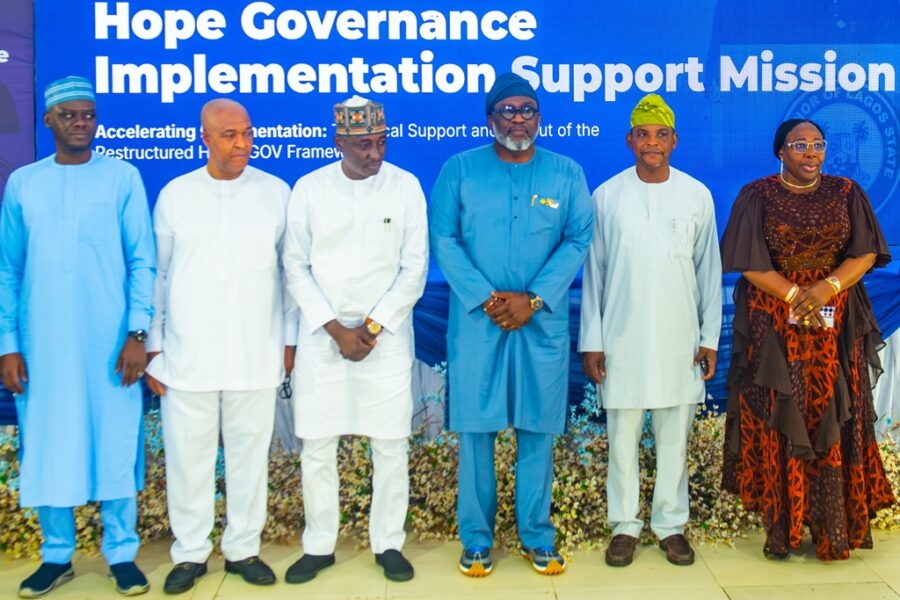
As part of broader efforts to boost human capital development across Nigeria, key stakeholders have underscored the critical role of sound public financial management in transforming primary healthcare and basic education.
Speaking to the media during the 2-Day HOPE-Governance Implementation Support Mission for the Southwest region, hosted by the Lagos State government, at Marcellina’s Place, Ikeja, the National Coordinator of the HOPE-GOV Programme, Dr. Assad Hassan, detailed the scope and objectives of the initiative.
The national coordinator stated the programme was domiciled in the Federal Ministry of Budget and Economic Planning, noting that the HOPE Governance Programme was a $500 million investment designed to improve financial and human resource management in primary healthcare and basic education across all 36 states and the Federal Capital Territory, FCT.
Dr. Hassan explained that while sister operations—the HOPE Primary Health Care and HOPE Basic Education Programs—focused directly on service delivery, the HOPE Governance Program targetted the central engine of execution: public financial management.
“We’re trying to see how we improve budget planning and execution in the two sectors,” Dr. Hassan said, noting that 388 officials from the 36 states and the Federal Capital Territory, FCT, were recently trained in proper budget planning and execution for Fiscal Y2027.
“The whole aim is that at the end of the day, every Naira that is budgeted for these two sectors in each of the states should have a realistic implementation pathway,” he said.
Weighing in on the education components of the initiative, the Lagos State Commissioner for Basic and Secondary Education, Mr. Jamiu Tolani Alli-Balogun, emphasised that the state’s vision was centered on building a better future for Nigerian children regardless of their social background.
Highlighting the growing nexus between education and technology in Lagos State, Mr Alli-Balogun noted that digital interventions were being leveraged to track attendance, classroom participation, and learning outcomes.
He noted the key pillars of the state’s education drive to include: Teacher Capacity & Professionalism: enhancing teacher recruitment, professional development, and motivation to ensure high-quality delivery in classrooms; Equitable Access: reaching out-of-school children across Lagos State through specialized foundational programmes (“Project Zero”) that integrate vulnerable children back into school environments equipped with necessary learning materials, uniforms, and textbooks.
Others are Digital Learning Integration: distributing smart learning devices to senior secondary school students to elevate their academic performance and preparedness for external examinations like WAEC and Resource Distribution: ensuring the equitable distribution of core textbooks—particularly in Mathematics, English, and Science—across over 1,028 primary schools and 275 junior secondary schools in Lagos State.
Addressing bottlenecks and pushing for positive results, Senior Public Sector Specialist from the World Bank and Team Leader of the HOPE Governance Programme, Mr Ikechukwu Nweje, noted that the programme was utilising a “Programme for Results” instrument, where states leverage their own systems to achieve predefined milestones and are rewarded upon verification.
While acknowledging initial implementation delays and early performance hurdles, Nweje expressed optimism for upcoming verification rounds.
He emphasised that the interventions directly addressed critical systemic deficits, such as severe shortages of teachers in classrooms and skilled birth attendants at primary healthcare centers—factors closely tied to Nigeria’s maternal and child mortality indicators, as well as the out-of-school children challenge.
He said: “You can’t teach children when there are no teachers or properly qualified teachers in schools. You can’t reduce maternal mortality or child mortality when you don’t have skilled birth attendants.”
He added that the World Bank’s fundamental goal as a development cooperative was to tackle poverty from the foundational stage by ensuring children were properly educated and that mothers and newborns survived.
In his goodwill message, Commissioner for Economic Planning and Budget in Lagos State, Mr. Ope George, emphasised the importance of institutional mechanics, budget credibility, payroll integrity, and evidence-driven resource deployment, stating that the technical restructuring mission provided an invaluable platform to protect sectoral investments and ensure equity in frontline workforce deployment.
He added that “effective governance demands that we periodically test our strategies against operational realities.”
Likewise, the Permanent Secretary, Ministry of Economic Planning and Budget, Lagos State, Mrs Olayinka Ojo in her welcome remarks, noted that the leaderships of the region remain committed to providing the counterpart coordination, institutional authority, and administrative ownership necessary to make the programme a reference model for subnational delivery.
Mrs Ojo expressed gratitude to the World Bank and the Federal Ministry of Budget and Economic planning Joint Task Team for the technical partnership and responsiveness to subnational dynamics.
As part of the participants, the focal person and the Director of Multilateral Relations in the Ministry of Budget and Economic Planning, Ekiti State, Mr Lawrence Omoniyi, said that his state had actively leveraged the framework to bolster grassroots human capital by employing approximately 1,700 health workers and 1,000 teachers for basic education.
The stakeholders engagement is a 2-Day even which started on Tuesday, 10th November and concluded on Wednesday 11th November 2026, an Implementation Support Mission of the Nigeria Human Capital Opportunities for Prosperity and Equity-Governance (HOPE-GOV) Programme, featuring officials of the World Bank and representatives of participating South-West states.
READ ALSO:
Tinubu rewards Flamingos with N100m savings bond each
Nigeria mining tax summit gets new date
Tinubu’s campaign council reorganises media structure
From the shadow of The Beatles to the feet of Christ
Tunde Kelani’s sacred gong and Jogbo’s chiefs
Troops apprehend father, son for alleged terrorism in Sokoto forest
Dr Pearse: Tinubu’s accuser who indicted himself
Alleged land grabbing: Ogun communities protest arrest of Seye Olatunji
CAF postpones 2026 Awards in Lagos
NAHCON, Saudi Arabia sign 2027 hajj agreement
Army rescues 30 kidnap victims in Niger, Plateau, Bauchi
Oyo 2027: Makinde’s ex-CoS, Ogunwuyi, 32 others defect to APC
What is it like to build a fintech business on the continent?
In Dutse, Tinubu reaffirms determination to overcome insecurity
Police confirm escape of two Kogi prison inmate, launch manhunt