


By SANMI FALOBI
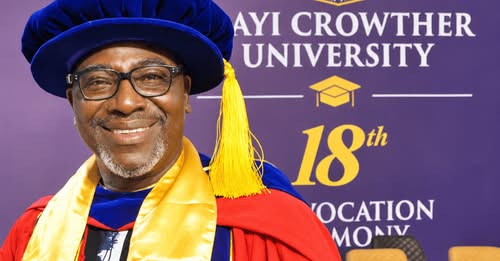
There are moments in life when the applause is not merely for what has been achieved, but for the journey it took to get there. For Lanre Arogundade, the moment he stepped out as his name was called among the PhD graduands at Ajayi Crowther University’s 18th Convocation Ceremony was one such moment. It signified a celebration of years of professional experience, intellectual curiosity, perseverance and an enduring commitment to learning.
For what it was worth, pursuing a PhD for a man whose career has been spent in the newsroom, in the trenches of media capacity development, in advocacy for advancing the media’s role in democratic governance, and in championing press freedom, journalists’ safety and professionalism, was not merely about acquiring a doctoral title. It was an achievement that carried a compelling message: that the pursuit of knowledge has no expiry date, and that even after years of professional accomplishment, there is always room to learn, discover, grow and renew one’s relevance.
Indeed, while the Executive Director of the International Press Centre (IPC) had earned himself a new title and could now be addressed as Dr Lanre Arogundade, the story behind it is one of a career spanning 40 years and encompassing service across activism, journalism, media development and the civil society space.
A Journey forged in Activism
A widely travelled journalist, media development practitioner, media and elections specialist, trainer and freedom of expression advocate, Arogundade’s professional career is built around the conviction that the media has an essential role to play in national development.
As Executive Director of the International Press Centre (IPC), Lagos, he has continued to advance this principle through institutional leadership, professional training, advocacy and research.
Among the defining chapters of Arogundade’s life is his activism, which predates his professional journalism career. As a student of the University of Ife, now Obafemi Awolowo University, he was immersed in student activism and campus journalism—experiences that would become formative in his engagement with politics, human rights and the struggle for democratic freedoms.
His involvement in activism extended beyond student politics. He was also associated with pro-democracy, human rights, workers’ rights and youth rights movements, including the Committee for the Defence of Human Rights, Campaign for Democracy, National Conscience Party and Campaign for Democratic Workers’ Rights. These engagements reflected the breadth of his interests and his commitment to the protection of rights, democratic participation and social justice.
From Student Activism to the Newsroom
He served as President of the National Association of Nigerian Students (NANS) between 1984 and 1985, a period of intense political turbulence in Nigeria. His activism during this era placed him on the radar of security agencies, with consequences that extended far beyond his years as a student leader.
His years in student leadership would later find echoes in his work within the journalism profession, including media work experience at The Republic, National Concord, Vanguard, Panos Radio, Voice of America and African Flame. At National Concord, he served in the features department, progressing through roles that included Features Editor and Chief Correspondent, while at Vanguard, he served as Assistant Editor and was also a member of the Editorial Board. These roles placed him within the demanding world of editorial decision-making, news production, public discourse and the responsibility of journalism to society.
Through his engagements with Panos Institute West Africa, he reported on media, governance and development issues, including community radio and oral testimonies, while his work with Voice of America involved reporting on democracy and governance, civil society, labour, young adults, human rights, women and media issues.
However, his professional ambitions were never confined to the newsroom. He increasingly became involved in the wider struggle to protect journalists’ rights, strengthen professional standards and ensure that the media could perform its watchdog role without undue interference, intimidation or fear.
Standing up when Press Freedom was under Siege
As Chairman of the Lagos State Council of the Nigeria Union of Journalists (NUJ) from 1995 to 1999, he became involved in campaigns against military-era assaults on press freedom and journalists’ rights. His leadership coincided with a period when independent journalism and pro-democracy advocacy were often met with repression, intimidation, arrests and the closure of media organisations.
It was a period in which the defence of press freedom required more than statements of principle. It demanded organisation, courage, mobilisation and a willingness to confront power. Arogundade and fellow media advocates were part of that struggle, contributing to resistance against restrictions on the press and the broader campaign for democratic restoration.
In recognition of his contribution, in 1997, he was a co-recipient of the maiden Press Freedom Award of the West African Journalists Association (WAJA) in The Gambia, partly in recognition of the Lagos State Council of the NUJ’s role under his chairmanship in fighting military repression of media freedom and the arrests and detention of journalists. The Nigeria Union of Journalists later honoured him with its Press Freedom Defenders Award in recognition of his contributions to the defence of press freedom. These honours reflected a career in which advocacy for the freedom and rights of journalists was not a peripheral interest, but a central commitment.
The evolution from student activism to journalism and media advocacy also reflects his leadership as Executive Director, International Press Centre, IPC, steering the organisation’s work in media capacity building initiatives for enhanced engagement with issues of national development, access to the media by marginalised groups, advocacy for freedom of expression, access to information, media independence, and strengthening the media’s contribution to democracy, governance and sustainable development. He also serves as Editor-in-Chief of Nigerian Democratic Report (NDR), further extending his engagement with public affairs, democratic governance and journalism.
Under his leadership, IPC has pursued a broad range of media development interventions, working with local and international partners to provide platforms for journalists to strengthen their skills, deepen professional standards, including journalists’ capacity-building and professional training on election reporting, fact-checking, gender responsive and conflict sensitive reporting, access to information, ethical journalism, press freedom and media accountability.
A trainer, author and global leader
Arogundade’s expertise has also been demonstrated through his work as a trainer and facilitator in investigative journalism, fact-checking, social media use, media monitoring, development reporting, corruption and budget reporting, gender reporting, and community reporting, among others. His professional engagements have involved working with media practitioners, civil society organisations, development partners, and other stakeholders on strengthening media practice, democratic participation and accountability, in Nigeria and beyond. His work has also involved research, curriculum development, preparation of training manuals, media sustainability assessments, consultancy assignments and advocacy initiatives.
Arogundade’s contribution to the profession has also been expressed through writing, editing and publishing. He is the author of Media and Elections: Professional Responsibilities of Journalists. Others include Fela: Yesterday’s Message As Today’s Reality (2017) and Breaking Your Head With Coconut (Akowe’s Journey in Student Unionism) (2022).
He has contributed to and edited a number of media resource publications addressing investigative journalism, public procurement reporting, budget and corruption reporting, media ethics, conflict reporting, freedom of information, civil society engagement and the rights of female journalists. Among these are the Public Procurement Reporting Guide, Guidelines and Resources on Investigative Journalism, The Ethics Handbook, Budget and Corruption Reporting: A Media Audit, We Speak for Us – A New Experience in Advocacy Work, Guidelines on Conflict and Election Reporting and Journalists’ Ethics and Self-regulation – Preserving Media Independence.
His professional engagements have also included work as a consultant, trainer, researcher and resource person for local and international media and development organisations.
His influence has also continued to expand beyond Nigeria. In July 2026, Arogundade was elected to the Council of the International Freedom of Expression Exchange (IFEX), a global network of organisations dedicated to defending and promoting freedom of expression. Subsequently, he was elected Deputy Convenor of the Council and also became a member of its Governance Committee.
The appointments placed him within the leadership structure of an international network that works across countries and regions to respond to threats to freedom of expression, support advocacy and strengthen the global movement for free speech and media rights. They represent recognition of the depth of his experience and the relevance of his work in a global environment where journalists, activists, media organisations and citizens continue to confront threats, censorship, digital repression and restrictions on access to information.
And now, the doctorate.
Arogundade successfully defended his doctoral thesis on 21 October 2026 at Ajayi Crowther University’s Faculty of Communication and Media Studies. Titled “Psycho-social Factors and Political Economy Elements of the Safety of Journalists and Media Professionalism in Nigeria,” the research brings together many of the strands that have defined his career. The research examines journalists’ safety not simply as an issue of physical protection, but within the wider realities of professional practice, economic pressures, institutional conditions and the psychological experiences of those who work in the media.
The subject of Arogundade’s research directly intersects with many of IPCs institutional engagement, particularly journalists’ safety, media professionalism, the political and economic conditions affecting media practice, and the psychosocial realities confronting journalists.
It also reinforces the value of combining professional experience with rigorous research and evidence-based advocacy. The doctorate is not simply an academic qualification added to an already accomplished career; it represents an intellectual engagement with a profession and a cause to which he has devoted much of his working life.
Education and work: A Message to Professionals
The doctorate is also a message to professionals who may believe that the demands of work, leadership, family and other responsibilities have placed further academic ambitions beyond their reach.
Arogundade’s journey offers a counter-narrative. It suggests that professional experience can be a foundation for further learning rather than a reason to stop; that questions emerging from years of practice can become the basis for rigorous academic inquiry; and that the pursuit of knowledge is not necessarily restricted to those who follow a conventional academic path uninterrupted.
His achievement consequently serve as an inspiration to journalists, media practitioners, development professionals, civil society actors and younger professionals who aspire to deepen their knowledge, advance their careers and contribute to society through research and professional practice.
For those who have followed his journey, the PhD is a moment to celebrate not only Lanre Arogundade’s academic achievement, but also the body of work, sacrifices, advocacy and leadership that have brought him to this point.
It is a celebration of a man whose journey has taken him from the frontlines of student activism to the newsroom, from press freedom struggles to institutional leadership, from national advocacy to global engagement—and now, from professional experience to doctoral scholarship.
READ ALSO:
Ex-convict, 78-yr-old grandpa, 74-yr-old grandma, couple arrested over colos, skunk
INEC disowns NEIS, warns against fake mock election results
APC campaign council dismisses NEIS mock election figures as fraudulent
2027: Nigeria must break free from the orgy of violence
Pete Edochie: An institution that came as human
My mother: Some memories are forever evergreen!
Magodo residents raise the alarm over alleged violation of govt directive by Adeyiga family
Adebule for burial today as Lagos APC suspends campaign
Kano recruits 1,000 forest guards to fight banditry, kidnapping
Adebule’s death, a painful loss to Nigeria -Tinubu
BREAKING: Lagos former deputy governor, Idiat Adebule, is dead
Tinubu approves Eastern gas pipeline, rail line, urges Igbos to vote for APC
Yul recalls Pete Edochie’s final moments at hospital
Alaba traders write security agencies, govt: Obi’s visit to market could cause mayhem