

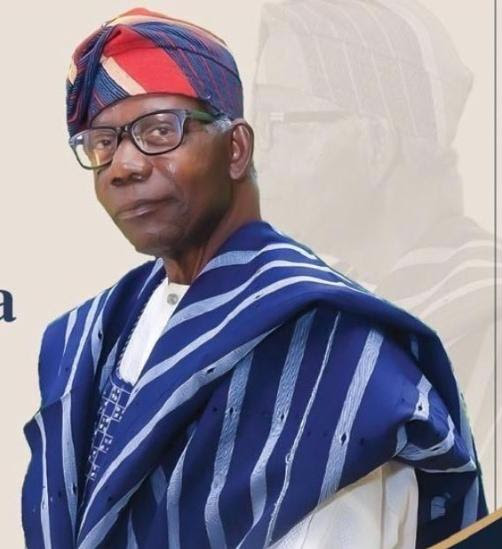
By SALIHU OTHMAN ISAH
In Yoruba cosmology, the Iroko is not just a tree. It is a presence. It does not fall easily. It dominates the forest by its height, its depth, its quiet authority. When the wind rages, smaller trees bend, break, and scatter. The Iroko remains.
That is Lade Bonuola. That is Ladbone.
Last Wednesday, at the Lagos City Hall, the Nigerian press gathered not to mourn an Iroko, but to celebrate one. Oyinlade Bonuola, the legendary journalist’s journalist, editor’s editor, turned 80. And in that hall, chaired by Aremo Olusegun Osoba, himself a journalist-governor, with a book – _Ladbone: A Life in Print_ – unveiled by the Centre for Journalism, Innovation and Development (CJID), we saw what an Iroko truly means.
Born in Kishi, in the northernmost rim of Oyo State, from the fertile hills where Yoruba meets Baruba, Bonuola vaulted from that modest outpost into a national reckoning. He did not come with noise. He came with craft.
He started at the Daily Times, then the king of Nigerian journalism. From sub-editor to Features Editor, Deputy Editor of Spear Magazine, he learned the cold discipline of facts, language and deadlines. But it was his column, “Caught Out”, written under the pen-name Ladbone – a contraction of Lade Bonuola – that made him immortal. Every morning, he spotted grammatical and factual errors in newspapers across the country. He shamed us. He taught us. He enforced standards when there was no Press Council to do it. The nickname stuck. It became an institution.
In 1983, when Chief Alex Ibru, Dr. Stanley Macebuh, Dr. Yemi Ogunbiyi, and (now late) Dr. Patrick Dele Cole gathered to birth a newspaper that would change Nigeria, they needed a man who could define editorial excellence. They found Ladbone. He became the pioneer Editor of The Guardian (1983-1988) and later Managing Director of the Guardian Group (1989-1999).
Under Ladbone, The Guardian was not just a newspaper. It was a University. It was a monastery. It was the Republic of Letters.
He introduced innovations Nigeria had never seen. “Cause List” – publishing the list of cases in courts – the first in any Nigerian newspaper. “Flight Guardian” – publishing daily flight schedules of all national carriers. Grammar had to be pure. Facts had to be sacred. Heads had to sing.
Ask those who passed through his hands. Ray Ekpu, Dan Agbese, Ted Iwere whom he literally arrested at Murtala Muhammed International Airport to beat Dele Giwa to employment, Femi Kusa, Babafemi Ojudu, Dapo Olorunyomi – who organised the 80th celebration – Jahman Anikulapo, Martins Oloja. He turned rough copy into readable prose and eager recruits into formidable professionals.
But Ladbone’s greatness was not just in editing copy. It was in moral courage.
He lived through the darkest nights of Nigerian journalism. Decree 4 of 1984 that jailed Tunde Thompson and Nduka Irabor. The closure of The Guardian by General Sani Abacha. The assassination attempt on Alex Ibru when he was shot in the eye by Abacha’s hounds. The exile, the fear, the temptation to compromise.
Ladbone refused to fold. He obeyed traffic light at 2am on his way home from Rutam House when no policeman was watching. He spiked a well-written editorial in the dead of the night not out of cowardice, but to protect the institution that employed hundreds, after his publisher rushed in bathroom slippers. He knew when to fight and when to preserve the platform for tomorrow’s fight.
That is the burden of an Iroko. It does not shout in the marketplace. Its strength is in quiet, unobtrusive energy, solemn resolve, immovable fixity against untruth.
In such a moment, Ladbone’s life reminds us of essentials: Facts must remain sacred; language must be clear; power must be questioned; talent must be nurtured; and journalism must retain the moral courage to examine itself.
After The Guardian, he co-founded The Comet, later The Nation, served as Managing Director, then Publisher of Nigerian Compass (2009-2011). He never stopped writing. His column, The RAM by Abdu Rafiu, still runs weekly.
For over 55 years of productive service, the honours have followed: Wole Soyinka Award for Investigative Reporting Lifetime Award for Journalistic Excellence (2020), Diamond Awards for Media Excellence (DAME) Lifetime Achievement Award (2021), Heroes of Democracy Award by NADECO (2026).
Yet, when you meet him, you meet humility. Of average height and build, woven in immense eruditional depth. He touches everyone with hope, inspires the trampled with rousing possibilities, spreading a constant cadence of renewal.
At his 80th, Babafemi Ojudu said it best in The Bone of Our Bones: “Ladbone was our teacher, our standard-bearer and our silent examiner. He was the presence that made a young journalist sit up when he entered the newsroom. He was our backbone. He remains the bone of our bones.”
The Nigerian press today faces enormous challenges that Ladbone warned about. Economic pressures have weakened newsrooms. Technology has disrupted old business models. Social media has democratised expression but also multiplied falsehood. Partisanship masquerades as journalism, while speed and sensation threaten accuracy.
In such a moment, Ladbone’s life reminds us of essentials: Facts must remain sacred; language must be clear; power must be questioned; talent must be nurtured; and journalism must retain the moral courage to examine itself.
Prince Uthman Shodipe-Dosunmu, the Oloriekun of Olowogbowo, in his chapter in the new book, recalls Ladbone telling him: “Prince, do you know that a tree can make a forest?” It was more than an enquiry. It was an affirmation.
One man, standing firm and unwavering against the ravages of the moment, holding the shield of righteous ramparts, can become a forest. Lade Bonuola did.
So, has the Iroko fallen? No.
The Iroko has stood for 80 years. Its roots are deep in Kishi, its branches over all of Nigerian journalism. Its seeds are in every newsroom where a sub-editor still checks a fact, where an editor still kills a cliché, where a journalist still chooses integrity over inducement.
Happy 80th birthday, Mr. Lade Bonuola – journalist of journalists, editor of editors and enduring guardian of the finest traditions of the Nigerian press.
The forest you made will not forget you.