
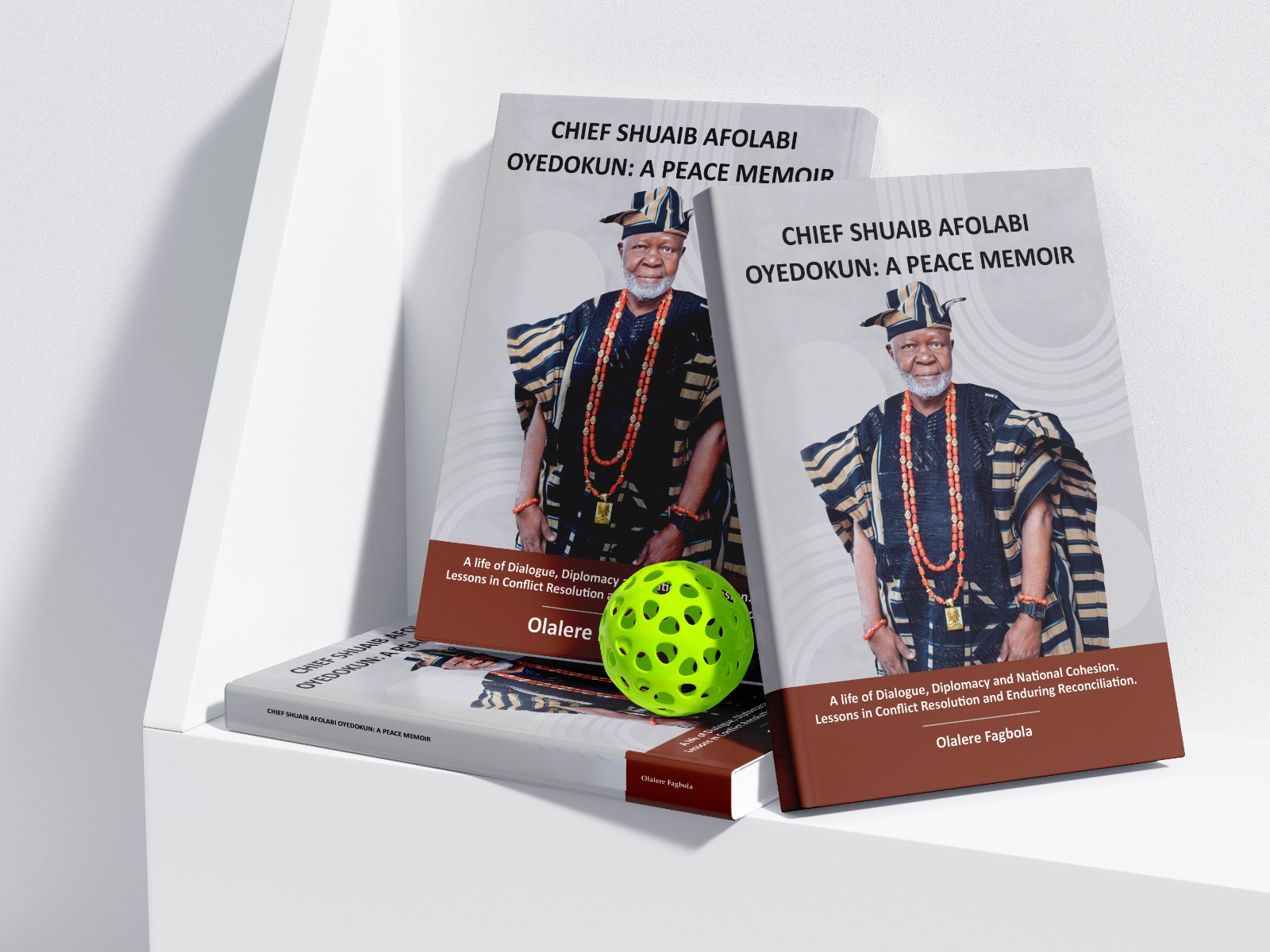
Book: Chief Shuaib Afolabi Oyedokun: A Peace Memoir
Author: Olalere Fagbola
Publishers: Dreadlocked Publishers, Osogbo
Number of Pages: 176
Year of Publication: 2026
Reviewer: Professor ‘Tunde Babawale
Introduction
The veteran journalist, Olalere Fagbola has presented to us a memoir of Chief Shuaib Afolabi Oyedokun to commemorate his 91st birthday anniversary.
Books are widely acknowledged as springs of wisdom, knowledge, experience and a source of intellectual and personal development. The ineluctable worth of books to mankind cannot be overemphasized.
Chief Oyedokun in this memoir has given us something to cherish, applaud and learn from.
The memoir which regales us with interesting stories about his past, is a treasure trove, a library to keep and a history to learn from.
It is a fact grounded in historical experience that when a lifetime or career is sufficiently exceptional and worthy of being treasured or preserved, such a life or career ought to be documented in book form for posterity.
Chief Oyedokun has added his voice and worldview to the infinite fountain of knowledge and inspiration that good books represent.
It is in this light that Chief Oyedokun’s memoir is a welcome addition to the rich corpus of memorable recollection of times, feats and God’s special favour on the life of our ageless, agile, energetic and tireless nonagenarian, Baba Shuaib Oyedokun.
The book is divided into 14 chapters spread over a hundred and seventy-six pages of racy, lucid and luminous prose chronicling the humble beginnings of Baba, his remarkable political career and the entire trajectory of his productive life. It enunciates the connection between peace and society’s development.
Chief Oyedokun’s life breaks the rules as he succeeded in situations where many predicted failures and rose up each time he fell, unyielding, unwavering in his determination to leave a legacy.
That legacy has turned out to be larger than his frame, if not larger than life.
The Opening
The book opens with the author expressing his gratitude to all whose contributions and support made the book possible. Olalere Fagbola, the veteran journalist, author, publicist and researcher expressed his appreciation to members of the Oyedokun family, some of whom, he interviewed, in the course of producing the book.
He did not leave out his colleagues who assisted in going through the draft to produce the excellent work.
Chief Yemi Farounbi who wrote the “Foreword” praised Alhaji Oyedokun’s advocacy for peace and his consistent exhibition of honesty, candour and principle – qualities that have become very rare in our clime at this time.
The Chapters
The first 4 chapters contain in great detail Baba’s humble beginnings in his hometown, Inisa, where the environment influenced his predilection for resolving conflicts and making peace without being cowardly. Inisa people are known to be war-like but also gifted with diplomacy and tact.
This is evident in the role Inisa played in the Jalumi war when it facilitated the defeat of the invading Fulani fighters while at the same time promoting peace within the different Yoruba armies that worked together to resist the invasion.
Baba Oyedokun’s legendary capacity for promoting peace and reconciliation is widely acknowledged. There is no doubt that this has endeared him to both his friends and political enemies. It also earned him respect and adoration from his political associates.
The account in the memoir is generous, the details are impressive and the capacity of Baba Oyedokun to recollect meticulous details of his past with names and even dates, is confounding.
Take for instance, the narration of his early life attempts at making peace and bringing about reconciliation. He vividly recalled an incident when he was a student at the Ansarudeen Teachers Training College, Ota, where a college Tutor M.S. Sorenson reported a student senior prefect named Oshin, who ignored the teacher when he was called. Alhaji Shuaib Oyedokun was at the scene as an eyewitness. The female teacher felt insulted by the prefect’s impudence and promptly reported to the school Board of Directors. A meeting was convened in the Assembly Hall and the eyewitness was invited to confirm whether the student refused to answer the female teacher’s call or not.
Baba Oyedokun was convinced that a ‘Yes’ or ‘No’ answer from him would be injurious to one of the parties in the dispute.
To avoid implicating any of the parties, Baba Oyedokun in response to the school Board’s request for a “Yes” or “No” answer from him, gave an ingenious response, to the effect that the prefect “answered but hesitated”.
The boy was reprimanded only for hesitating and the teacher left feeling that her authority had been re-affirmed.
Baba Oyedokun successfully made peace in several conflict situations among members of his political party and even within and outside his community in Inisa. The political crisis of 1983 led to the burning down of his house and his rich library containing books which he partly inherited from his father, Sheikh Alhaji Ibrahim Oyedokun, the then Chief Imam of Inisa, who was also known to have kept a rich library of essentially Islamic texts. In spite of the enormity of the loss he incurred in that crisis, Baba Shuaib Oyedokun still made peace with his political opponents by offering an olive branch.
He was reputed to have been the architect that helped in resolving the almost intractable political conflict that broke out in Anambra State in the post-1999 era.
He led the reconciliation moves that brought an end to the conflict between the Executive and the Legislature during the administration of former President Olusegun Obasanjo.
His reconciliatory efforts also got recognition in South Africa, where he was honoured with the prestigious Nelson Mandela Peace Award.
The life of Baba Oyedokun becomes the account of how one man with a gift of intuition and a passion for peace made other people’s business his business, restoring amity among seemingly implacable foes and bringing peace to communities of people. In doing this, he creates new paths for stability, development and social cohesion. Alhaji Shuaib Oyedokun’s life evinces intuition, resilience, selflessness and deep commitment to public service.
A man of spartan discipline, he lived a simple life divested of ostentation or flamboyance – qualities that signal contentment. No wonder he was excluded from the list of politicians arrested and detained for alleged corruption by the Buhari military junta when it sacked the Shagari – led civilian administration in 1983.
Baba Oyedokun’s thirst for promoting peace made him to put himself in the forefront of those who helped in reconciling Yoruba traditional rulers who were at each other’s throat at a time, through the instrumentality of “Egbe Ilosiwaju Yoruba”, under the chairmanship of Late General Adeyinka Adebayo.
Chapters 5-10 document Baba Oyedokun’s paths to peace and how his reconciliatory and reformist disposition is a trait that he inherited from his late father, Sheikh Alhaji Ibrahim Oyedokun. Chief Ibrahim Oyedokun himself made successful efforts to reform his immediate community and create an opening for peace. Believing that the institution of marriage in Inisa was being threatened by exorbitant bride price, he worked with like-minded individuals in the town to ensure that bride price was drastically reduced.
When Imam Oyedokun lived in the Gold Coast (now Ghana), he joined hands with other Inisa indigenes to form the Egbe Omo Ibile in 1944.
The Egbe was formed to promote the interest of his community back home. This singular effort laid the foundation for the eventual formation of the Inisa Descendants’ Union (IDU) which later became the union for all Inisa descendant in Nigeria and the Diaspora, and whose primary objective is the promotion of the social, political and economic development of Inisa town.
Surely, the apple does not fall far from the tree. It is no wonder that those traits are replicated in his son, Chief Shuaib Afolabi Oyedokun.
Religion, Politics, and Public Service
Chief Shuaib Oyedokun’s politics has been one without bitterness. He relates to people across the political divide and boundaries without discrimination. His worldview as revealed in the memoir has been shaped by Islamic spirituality, academic geography, public service and extensive social experience developed into a very strong instrument for promoting and propagating peace and mutual understanding among communities and across the country.
Chief Oyedokun is a highly cerebral and brilliant politician who started off with a career in teaching before he moved into politics. He actually has made a success of both. His rise in politics has been meteoric, starting off as the Secretary to the Oyo state chapter of the defunct National Party of Nigeria (NPN) and later rose to the position of Secretary to the Oyo State Government (SSG) under the administration of former Governor Dr. Omololu Olunloyo.
He was one of the founding fathers of the Peoples’ Democratic Party (PDP), and rose to become the Deputy National Chairman of the Party and Permanent member of the Board of Trustees (BOT) of the party. It is therefore not an accident that the Oyedokun villa in Inisa became the birthplace of many political associations. His Ajegunle office in Osogbo also became a go-to secretariat for politicians and activists alike.
Chief Oyedokun played an important role in drafting former President Olusegun Obasanjo into the Peoples’ Democratic Party (PDP), and later into the presidential race. He was requested to preside over President Obasanjo’s nomination convention for a second term in office in 2003.
Prominent Nigerians, like Late Dr. Omololu Olunloyo, the former Executive Governor of Oyo State, Chief Olu Alabi, Chief Yemi Farounbi, former Vice-President Namadi Sambo, former Governor Maikarfi, Hon. Benjamin Kalu, the current Deputy Speaker of the House of Representatives, spoke glowingly of their respect for Chief Oyedokun’s character and competence.
Among the people of his community, he is well respected as attested to by the positive comments of respected Inisa indigenes like Mr. Tunji Oyelade, Professor Labo Popoola and Chief Raji Asiyanbola, the Otun Baale of Inisa. In fact, Chief Asiyanbola revealed in an interview that the Oyedokun lineage in Inisa historically held the war title “Jagun Jagun Afelemu of Inisa” which can be translated to mean “the strategist who patiently waits for the right time to defeat his enemies”. This philosophy seems to undergird Chief Shuaib Oyedokun conflict management strategy and operational modality in politics. The strategy emphasizes patience and timing rather than reckless and tactless confrontation.
No wonder, he has been instrumental to electing governors, installing governments in power and helping many to climb the ladder to political prominence.
He regaled us with how the meetings in his villa assisted the Action Congress (AC) later the All Progressives Congress (APC) to gain power in Osun state. The book also showed how instrumental Chief Oyedokun was n the election of Ademola Adeleke, first as Senator and later as Governor of Osun State. He also mentioned the role he played in helping to secure Senatorial seats for Otunba Iyiola Omisore and Chief Felix Ogunwale.
Baba Oyedokun did not fail to express gratitude to those who assisted him in his political journey. He expressed his appreciation to the Owa Obokun of Ijesaland, His Imperial Majesty, Oba Celement Adesuyi Haastrup, the Olubadan of Ibadan – His Imperial Majesty, Oba Rashidi Adewolu Ladoja.
In a situation where reading books is becoming increasingly less fashionable, it is heartwarming and impressive to read this collector’s item from a nonagenarian; our icon, Chief Shuaib Afolabi Oyedokun.
He celebrated his decision to join the progressive camp after rejecting his former party the PDP to join hands with individuals he respects, in the APC.
He paid glowing tributes to Chief Bisi Akande, Prince Dotun Babayemi who he described as his co-traveller in his final political journey. He expressed further appreciation to former Governor of Osun State, Mr. Isiaka Adegboyega Oyetola, the National Secretary of the APC, Dr. Ajibola Basiru (SRJ), Mr. Femi Oyetola and others too numerous to mention in this review.
He also emphasized his commitment to the Renewed Hope Agenda of President Bola Ahmed Tinubu.
The political journey of Alhaji Shuaib Oyedokun has not been a smooth ride. It has been on some occasions marked by near-death experiences. Notwithstanding, he has learned to take the ups and downs in politics with stoic equanimity.
It is not a coincidence that the birth of the National APC Christian Leaders’ Forum (NACLFON) took place in Chief Oyedokun’s villa. It is a testimony to his broadmindedness and accommodation of difference.
Today, Chief Oyedokun, in addition to the well-deserved celebration of his birthday and the public presentation of this memoir, will also receive a Lifetime Achievement Award of the Council of American Peace Associates (CAPA), led by Professor Olanrewaju Abraham.
The award is being conferred in recognition of his consistent advocacy for peace and good governance.
Rightfully, the writer of the memoir concludes that the Oyedokun villa “is more than a political meeting ground. It becomes a deeper sense, a sanctuary of encounters – where politics, history, faith and destiny converge” I cannot agree with him more.
In chapters 11-14, what becomes confounding about Chief Oyedokun’s life as one read through the memoir, is not just his passion for politics or commitment to reconciliation, but his willingness to offer a helping hand to those who are in need. A man of deep religious conviction, he exhibits piety in everything he does. What many will find intriguing is the fact that Chief Oyedokun is a hardworking man.
When he lost the State House of Assembly elections in Oyo State in 1979, he directed his energies into business. He not only joined his wives in the sale of enamel wares, he also went into the sale of soft drinks, leather goods and also farming. At a point, he ventured into international trade in fish and shrimps. The lesson in this is that Chief Oyedokun laid a good example of how a politician can and should have a second address.
It was the legendary novelist Chinua Achebe who once said that “a chick that would grow into a cock will be spotted the very day it hatches”.
This applies to Chief Oyedokun’s inclination for settling disputes, reconciling people and making peace, a trait that had been noticed even in his adolescent years.
Indeed, many were impressed by the role he played in reconciling his father with his mother, after a period of separation. At a time when his father served as the Imam of Inisa mosque, he was able to bring together his father and some clerics who disagreed among themselves over some knotty issues in the mosque.
As a commendation for this effort, an elderly man present named him “Omolaja” (The child that brokers peace). His achievements are not limited to peace and reconciliation. He also has an unwavering passion for education.
When Sheikh Ibrahim Oyedokun served as Imam of Inisa, a suggestion for the establishment of a secondary school to complement the existing modern and primary schools was made. Chief Oyedokun was invited to coordinate the efforts to establish the school in Inisa. He, along with others like Pa Ibikunle, Chief Raji Olokuta, Pa Olowolagba and Chief J.A. Woye, successfully ensured that the Ansarudeen Comprehensive High School in Inisa, was established.
Chief Oyedokun’s peace-making efforts and his advocacy for inter-religious harmony did not go unrecognized or unnoticed.
St Peter’s Church, Inisa gave him “The Golden Father’s Award” while he also received the title of “Baba Adini of Inisa”. He also received awards from the Ansarudeen Society. He was turbaned the “Asiwaju Adini” in 2005. He received the “Award of Excellence” from St Paul’s Anglican Church in 2014 and a special recognition by the Inisa Anglican Congress in 2021.
Although, it is often said that a prophet is without honour in his own home. This is not the case with Chief Oyedokun who was given the unique title of “Oluomo of Inisa” (the star son of Inisa or Golden son of Inisa) by the Olunisa of Inisa and the Olunisa-in-Council.
He got the Nelson Mandela Award for political crisis management in far away South Africa, and also received commendation for serving as Chairman of the most peaceful PDP Presidential convention in 2003.
His record of achievements in public service is equally remarkable.
He had served with distinction as Chairman of Michael Imoudu National Institute for Labour Studies (MINLS). In recognition of his outstanding record of service, the Institution conferred on him, the award of “Fellow of the National Institute”, in 2012. He also had the conference building of the Institute named after him.
His record as Chairman of the Board of Management (BOM) of the Ahmadu Bello University Teaching Hospital (ABUTH) made the institution to name its geriatric care centre as the “Oyedokun Geriatric Care Centre”. He has had the distinct honour of being awarded chieftaincy titles outside his own domain.
He is the “Jagunmolu of Erin-Osun”, “Agbaakin of Apete” and “Omoloju of Ola” – a place where his wife Alhaja Olateju Olufunmilola Oyedokun hails from.
Chief Shuaib Oyedokun’s Family
Reading through the book, it is crystal clear that Baba Oyedokun is a happy and contented family man. It is also evident that he grew up in a cohesive polygamous home where Yoruba culture, values and civilization are cherished.
On the Book
As I mentioned earlier, the language of the book is lucid, simple and the narration linear. I did not find in the book, any ambiguities, or complexities.
Although what was made available to me to review was the e-copy, I still found it well-written and the text complemented with photographs and images that tell the success stories narrated in the one hundred and seventy-six pages of the book.
However, some minor typographical and textual errors should be corrected in subsequent editions of the book. For example, on p. 20, “Noah’s ark” is misspelt as “Noah’s arch”.
The repetition of a whole paragraph starting with “for the people of Inisa… on both pages 32 and 33 should be corrected. The sentences in the paragraph ought to be retained on p. 32 and those on p. 33 should be deleted.
In a situation where reading books is becoming increasingly less fashionable, it is heartwarming and impressive to read this collector’s item from a nonagenarian; our icon, Chief Shuaib Afolabi Oyedokun.
I can confidently say that all hope is not lost for us and that any investment in education or books yields high and valuable dividends as exemplified in the life of Baba Oyedokun.
Conclusion
I wish to conclude by congratulating Baba for this motivating, inspiring and captivating book. I identify with many of the experiences he shared in his political odyssey and attest to the fact that Chief Oyedokun’s life has been a glorious path, a life of selfless service and commitment to peace and reconciliation.
Baba has channelled his knowledge into taking practical steps concerned with the betterment of society and peaceful co-existence.
May he continue to live long, in good health, to lead the rest of us, especially his fellow-politicians and co-travellers, along the path of rectitude and moral standards for the entrenchment of peace, stability and unity in our great country.
I thank you all for your attention.
READ ALSO:
INTIMATE AFFAIR: Are today’s sons prepared for today’s daughters?
WEATHER FORECAST: NiMet predicts sunshine, cloudiness
CVR: INEC extends deadline, introduces self-service registration
Why Nigeria’s counter-insurgency strategy failed –Retired Colonel
W’Cup: Colombia secure 1-0 win over Ghana to reach Round of 16
Osun election: I-G orders crackdown on criminals
Equities market rebounds with N3.16trn gain
W’Cup: Egypt triumph 4-2 on penalties after 1-1 draw with Australia
APC state chairmen meet in Lagos, strategise ahead of 2027
Navy discovers illegal fuel storage site, recovers 18,000ltrs of AGO
NSCDC arrests two suspects over alleged job racketeering in Oyo
Ogun guber: US-based Bolaji Odusina wins NDC ticket
WorldStage: How to build world class corporate culture –Baale