

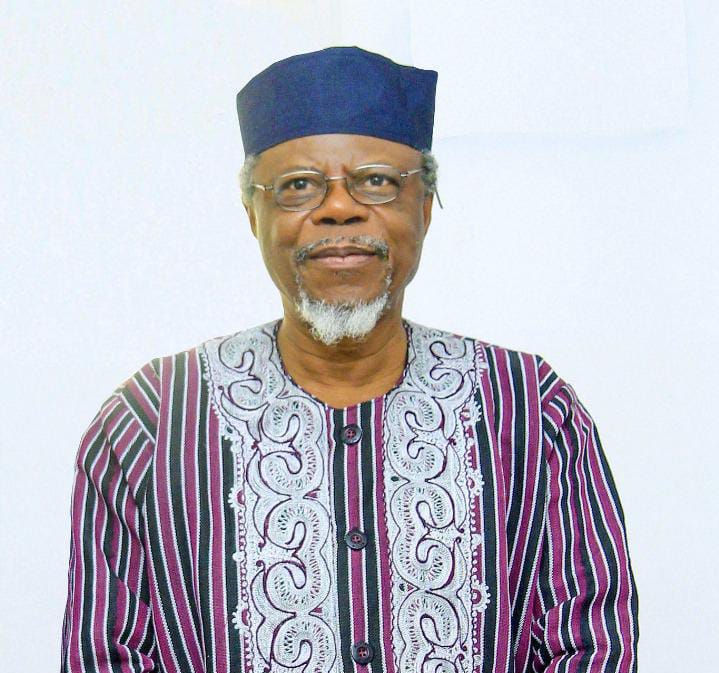
“No world power can kill Africa”. That was the emphatic declaration of renowned historian and internationally-acclaimed scholar, Prof. Toyin Falola.
He made the declaration as he challenged Africans to abandon the belief that the continent is condemned to perpetual underdevelopment and instead confront the internal structures, values and failed development formulas that continue to hold it back.
Falola argued that Africa had survived some of the most devastating forces in human history—from the trans-atlantic slave trade and colonial exploitation to political instability and economic dependency—and yet continued to produce intellectuals, professionals, entrepreneurs, artists and innovators whose contributions were sought across the world.
He spoke on Sunday night during the 47th edition of Boiling Point Arena, a hybrid media discourse platform, which focused on the theme, “The Africa We Want: Can the Continent Break Free From the Cycle of Underdevelopment?”
The discourse hosted by a Communication Strategy Expert, Dr. Ayo Arowojolu via Zoom, was also broadcast live on seven partner radio stations across Lagos, Ogun and Delta states.
Frontline traditional ruler, the Olowu of Owu Kingdom, Oba Prof Saka Matemilola, chaired the interview discourse.
“Nothing can kill Africa,” Falola declared, stressing that anyone who believed that anything could permanently defeat the continent did not understand Africa’s history.
But the historian’s optimism came with a warning: Africa’s greatest challenge today may not be whether the continent can survive, but whether it can transform itself.
According to him, Africa cannot escape underdevelopment by continuing to pursue the same political and economic formulas that have repeatedly failed.
What was required, he argued, was a fundamental transformation of institutions, values, economic systems and political imagination.
In an extensive and intellectually provocative conversation over a two-hour duration, the professor presented a counter-narrative to the familiar story of an Africa defined principally by poverty, corruption, conflict and institutional failure.
His argument was that Africa was not a continent waiting to be rescued, but one that must learn to organise, retain and convert its enormous resources into sustainable development.
Africa Has Survived Worse
Falola’s contention about Africa’s resilience was deeply rooted in history.
He pointed to the trans-atlantic slave trade, during which Africa suffered the loss of millions of people, as evidence of the extraordinary resilience of the continent and its people.
Yet Africa survived.
He also drew attention to the continued global demand for African-trained doctors, pharmacists, academics and other professionals.
According to him, while African institutions are frequently disparaged, professionals trained in Africa continue to be recruited by developed countries, demonstrating that the continent possesses considerable human capacity.
The challenge, therefore, is not simply a lack of capable people.
Rather, Falola argued, Africa’s deeper problem was its inability to consistently organise its human and material resources into productive systems capable of generating and retaining wealth.
He urged Africans to recognise the many success stories within their societies that were often overshadowed by predominantly negative narratives about the continent.
The Enemy is Not Only Outside Africa
While acknowledging the historical forces that have shaped Africa’s present condition, Falola’s argument went beyond blaming external powers.
He challenged Africans to examine the internal structures, values and institutions that continue to reproduce underdevelopment.
Africa, he argued, could not continue to blame external forces while maintaining systems that encouraged extraction, patronage, capital flight, weak institutions and dependence on imported goods and ideas.
“We can break free from this underdevelopment, but we will not be pursuing this challenge by doing the same development formulas,” he declared.
He illustrated the point with a parable from Jomo Kenyatta’s Facing Mount Kenya, explaining that once a crisis was understood as a process rather than an unchangeable condition, the possibility of transformation became visible.
Underdevelopment, therefore, should not be treated as Africa’s permanent identity.
It is a historical process—and what has been historically produced can also be historically transformed.
For Falola, one of the most urgent requirements for an Africa seeking development is a decisive shift from extraction to production.
African countries, he said, must stop exporting raw materials only to import finished products made from those same resources.
“We must move from economy of extraction to that of production,” he said.
He called for a corresponding movement from import dependency to value creation, stressing that African countries should transform their agricultural and mineral resources into finished products.
“Convert your yam into product, convert the cocoa into value,” he said.
The professor argued that Africa must develop economies capable of reproducing themselves through their own productive capacities, institutions and knowledge systems.
He called for a transition from political patronage to capable institutions and from intellectual dependency to what he described as knowledge sovereignty.
Falola said Africa urgently needed what he described as a developmental state—one in which development is deliberately placed at the centre of government policy.
Such states, he argued, must have accountable institutions where political power is deployed for public purposes rather than private accumulation.
He also warned against capital flight, arguing that Africa must ask a fundamental question: how much of the value generated from its resources remains within the continent?
According to him, Africa would make greater progress if more of its wealth remained on the continent and was reinvested in infrastructure, industry, education and other areas of development.
He identified weak institutions, political predation, inadequate energy supply, mismatch between education and economic needs, insecurity and capital flight among the structural obstacles holding the continent back.
Education Must Produce, Not Merely Certify
Falola also challenged African countries to rethink their educational systems.
Education, he submitted, should not be reduced to the acquisition of certificates.
Rather, it must become a form of productive infrastructure that equips citizens with the skills required to transform their societies.
He advocated the revival of technical schools and trade centres while emphasising the need to treat young people as the continent’s future.
Africa’s large youth population, he argued, should not be regarded as a burden but as a demographic advantage that could become a major engine of development if properly harnessed.
He also highlighted the significant progress already made in African education, particularly in the education of women, arguing that such achievements deserved greater recognition.
One of the most sobering moments of the conversation came when Falola turned his attention to Nigeria’s political future.
Responding to questions about corruption, democracy and leadership, the historian issued a stark warning:
“Nigeria is yet to begin its problem.”
He argued that the country could face a much deeper leadership crisis if young people lose faith in education while becoming convinced that politics is the easiest route to wealth.
“If people don’t take their education seriously, if young people say education is a scam, people who say politics is the best business in town, it’s going to produce the worst leaders like that you ever get,” he warned.
Falola’s concern was therefore not merely about the individuals currently occupying political offices, but about the values and attitudes being transmitted to the next generation.
A generation that distrusts education but admires political wealth, he suggested, could eventually produce leaders whose values deepened rather than resolved Nigeria’s problems.
Democracy Without Accountability
Falola also offered a critical assessment of the relationship between democracy, corruption and accountability in Nigeria.
“Nigerians are fighting for democracy, but they are not fighting for accountability,” he said.
He said Nigerians had concentrated heavily on democracy while paying insufficient attention to the institutions and values required to make democracy produce good governance.
Transparency and institutional accountability, he maintained, must be treated as separate but equally essential priorities.
He further argued that Nigeria’s political structure created incentives for corruption, making it insufficient merely to appeal to politicians to stop stealing.
The solution, in his view, lies in building institutions and enforcement mechanisms capable of making corruption costly.
Restructure Values, Not Only The Federation
Perhaps one of Falola’s most profound interventions came during the discussion on political restructuring.
He argued that Nigeria’s persistent obsession with restructuring the federation could overlook a more fundamental issue—the need to restructure values.
He acknowledged the importance of political restructuring but warned that changing the political structure without changing the values of the people operating it would not necessarily produce the desired transformation.
“The fact that you restructure politics does not mean you are restructuring values,” he argued.
Even if Nigeria were to radically restructure its federation, he suggested, corrupt politicians would not automatically disappear.
Without a corresponding transformation of values, political restructuring could therefore fail to deliver the revolutionary consequences many Nigerians expected, he reasoned.
Investors, entrepreneurs, policymakers and business leaders have called for increased investment in Nigerian businesses and human capital as the country seeks to prepare its workforce for a rapidly changing global economy.
The call was made at Investors Connect London 2026, convened by Vivacity Development in collaboration with its UK partner, Codub Consulting Ltd., at Imperial College London on Thursday, September 10, 2026.
The event brought together stakeholders from Nigeria, the United Kingdom and the wider African diaspora to discuss investment, enterprise development, innovation, global partnerships and the future of work.
The gathering was convened by the Founder and Chief Executive Officer of Vivacity Development, Engr. Oluwakemi Ann-Melody Areola, who argued that Nigeria’s future-of-work conversation should extend beyond emerging technologies and include the businesses already providing jobs and livelihoods.
Following the London gathering, Vivacity Development’s international engagement continues in New York on September 21, 2026, with its UNGA side event focused on work, innovation and opportunity and preparing the next generation for the global economy.
“If we are serious about building the future of work for Nigerians, then we must invest in the businesses employing Nigerians,” Areola said.
She stressed the need for Nigeria to rethink its education and skills systems in response to changing global economic demands, citing international efforts to align university programmes with emerging opportunities.
Areola said Investors Connect was designed to bring together “capital, enterprise, expertise, policy and international networks” around practical opportunities for growth.
Chidi Umeano, Principal Consultant at Codub Consulting Ltd., urged stakeholders to look beyond diaspora remittances and recognise Nigerians abroad as potential sources of investment capital, expertise, mentorship and access to international markets.
A keynote address by Dr. Sunday Akin Dare, Special Adviser to the President on Public Communications and Orientation, focused on building institutions capable of sustaining businesses beyond their founders.
Dare urged entrepreneurs to look beyond raising capital, stressing the importance of governance, technology, people, infrastructure, regulatory certainty and strategic partnerships.
He also encouraged founders seeking international expansion to understand local market realities and distinguish between market reach and genuine scalability.
The event featured discussions on sectors capable of contributing significantly to Nigeria’s employment and economic growth, including technology, healthcare, sports, the creative economy, agritech and sustainable labour mobility.
Speakers also examined the challenges confronting businesses seeking investment and the need to build enterprises with credible governance structures, financial discipline, intellectual property protection, compliance mechanisms and clear growth strategies.
A session titled “Golden Nuggets — The Architecture of an Investment-Ready Startup” was moderated by business strategist, Evelyn Esumai, and featured Dr. Lanre Phillips, Chief Executive Officer of LP Consults.
Another session, “The Governance Imperative,” explored the role of effective leadership and governance in building sustainable enterprises.
The discussion was moderated by Ebaide Omiunu, Founder, with Tom Cracknell, founder of Koyo Health, sharing insights on governance and sustainable business growth.
The programme also examined how African businesses could improve access to international markets, investment, partnerships and potential exit opportunities.
The organisers said the discussions were intended to move beyond networking by creating practical connections between businesses seeking growth and investors, institutions and professionals capable of supporting them.
Recent publicity from Vivacity described the 2026 programme as focusing on inclusive growth, innovation and multi-sector diversification, with the wider initiative designed to connect African businesses with global capital, expertise and strategic partnerships.
The closing session challenged participants to translate the relationships created at the event into measurable outcomes, including investments, partnerships, business expansion and job creation.
Areola said the success of Investors Connect should ultimately be measured by what happens after the conference.
“Potential becomes progress when the right people, the right ideas and the right capital connect,” she said.
The London event forms part of Vivacity Development’s wider international engagement programme on investment, workforce development and economic transformation.
The organisation has also outlined engagements in New York and other international locations as part of the broader programme.
READ ALSO:
Training for officials ahead of MOB national taekwondo contest
Affordable medical diagnostics through Akoda’s GenScan AI
NDLEA intercepts colos from UK, uncovers opioids in loaves of bread
Boiling Point: Falola leads discussion on Africa’s search for greatness today
INEC voter register bloated with multiple registrations -Okoye
Police launch rescue operation for six abducted Islamic clerics