



By MAX AMUCHIE
I have not come to mourn or grieve over a loss, painful as it is. I have come to meditate on, celebrate and situate in context an institution that was mortal, made of flesh and blood. An institution that lived, worked, created, influenced and, in the process, became part of the cultural inheritance of our shared humanity.
History sometimes creates institutions out of buildings, constitutions, organisations and established systems. But occasionally, history produces an individual whose personality, accomplishments and influence become so deeply embedded in the consciousness of a people that the individual himself becomes an institution.
Such people do not merely leave footprints in history. They leave an institutional presence in the memory of humanity.
They are rare. A generation may encounter thousands of talented people, celebrate hundreds of accomplished individuals and produce dozens of outstanding personalities. But it may not produce more than a handful whose presence becomes inseparable from the cultural identity, collective memory and historical consciousness of their time.
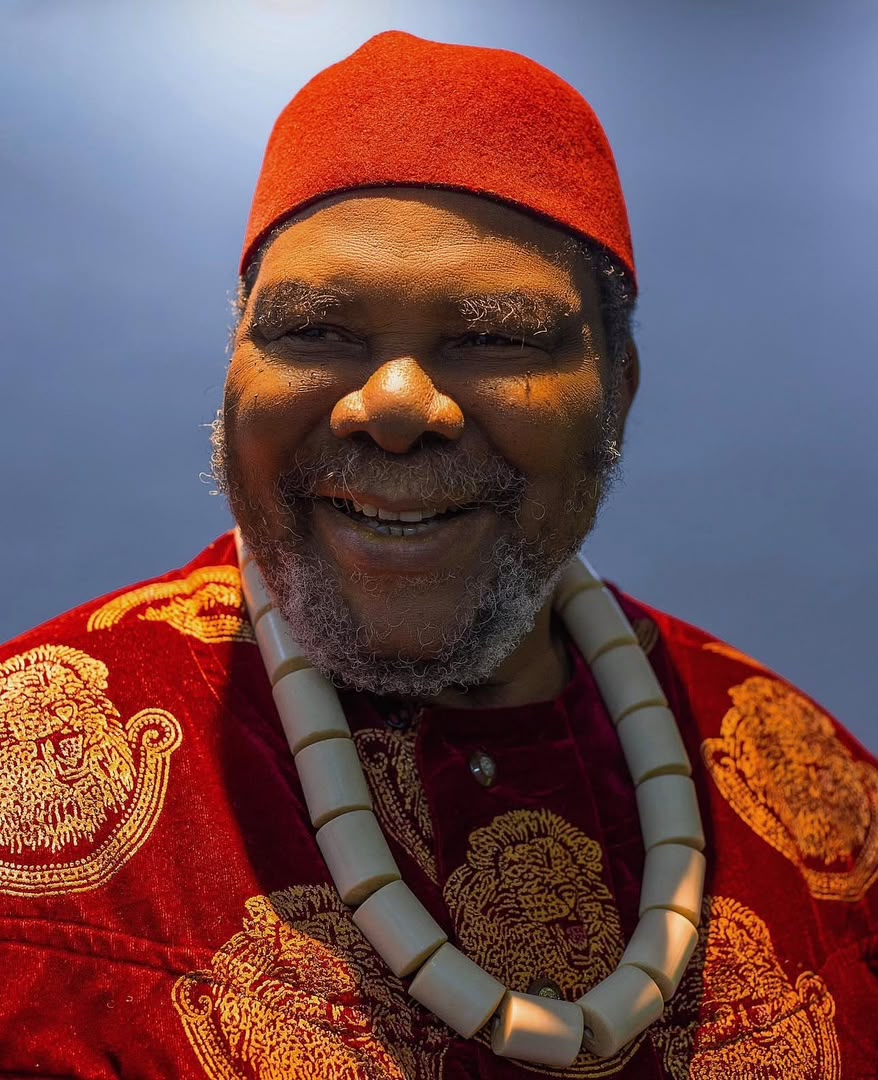
Pete Edochie was one such individual.
Beyond the Cultural Icon: An Institution in Our Collective Memory
In the days following his transition on Wednesday, 25 November 2026 at age 79 Edochie has been described as a cultural icon, a veteran artist and a cultural ambassador. He was all these. But so, too, have other accomplished individuals been described. These appellations, generous as they are, do not quite capture the magnitude of the man or the uniqueness of his place in our cultural consciousness.
Pete Edochie was more than these descriptions. He was more than the sum of his performances, his awards, his public recognition and his contributions to Nigerian cinema. He was an institution.
And there is a profound difference between being celebrated as an individual and becoming an institution in the collective memory of a people.
There is something profoundly moving about the departure of a person who had become more than his profession. When an actor dies, we mourn the artist, the performances and the characters they brought to life. But when someone like Pete Edochie departs, the feeling is different. We are confronted with the passing of a cultural institution, a familiar voice in our collective consciousness, a personality whose presence had become part of the way we recognised ourselves.
A generation does not get to see many people like Pete Edochie.
When Pete Edochie Became Okonkwo
To understand the magnitude of his cultural significance, one must return to Okonkwo.
When Chinua Achebe created Okonkwo in Things Fall Apart, he gave African literature one of its most enduring characters. Okonkwo was not simply a man of strength and ambition. He was a complicated representation of masculinity, tradition, pride, courage, vulnerability and the tragic consequences of an inflexible understanding of personal identity.
Then came Pete Edochie.
In his portrayal of Okonkwo, he accomplished something extraordinary. He did not merely interpret a literary character for television. He gave that character a human presence that would become inseparable from the imagination of generations of viewers.
His voice, bearing, temperament and commanding screen presence seemed to inhabit the character in a way that made the distinction between actor and role almost disappear.
For millions who encountered the television dramatisation, Okonkwo was Pete Edochie.
But Edochie’s contribution to this cultural experience went beyond his interpretation of Okonkwo. Through Chinua Achebe’s Things Fall Apart, African proverbial wisdom had found an influential place in world literature. Achebe famously described proverbs as “the palm-oil with which words are eaten”, capturing their importance as instruments of communication, philosophy, social instruction and collective memory. Edochie helped bring that tradition to life on television, giving its expressions a commanding voice and a memorable human presence.
The Philosopher Behind the Screen
Interestingly, his relationship with proverbs was not confined to the scripts he interpreted. In a February 2014 interview with Saturday Tribune, he was asked whether the proverbs audiences enjoyed in his movies were scripted or came from his personal repertoire. His answer was revealing: “They come from me.” When the interviewer asked whether he meant all of them, he replied, “Yes, everything.”
That exchange offers an important insight into the man behind the celebrated screen personality. Edochie was not merely delivering lines written by screenwriters; he was bringing his own repertoire of proverbial wisdom and philosophical observations into his performances.
His commitment to language was equally deliberate. In the same interview, he explained that he had rejected scripts filled with profanities because he did not want to abandon the standards of expression audiences associated with him. “I am a lover of linguistic decency,” he declared. He understood that people learnt from him and was unwilling to compromise the responsibility he believed came with his public influence.
Beyond the movies, Edochie offered observations that revealed a thoughtful understanding of human relationships and social conduct. On human interdependence, he likened people to the fingers of one hand, observing that when one finger is cut off, the entire hand feels the pain. On disagreement, he made a distinction that remains relevant in public discourse: “We can have intellectual disagreement but not market-women quarrels.”
His popular proverbial expressions were equally memorable. “Beware of the naked man who offers you clothes” is a lesson in discernment and the need to examine the intentions behind apparent generosity. “If you sell your father’s land to buy a trumpet, where will you stand to blow it?” is a warning against sacrificing one’s foundation for temporary gratification. And “The death of a lion cannot be announced by a goat” speaks to stature, significance and the weight of personalities.
These expressions, alongside many others associated with him, helped establish his reputation as one of the most recognisable proverbial voices in Nigerian popular culture. Not all the sayings attributed to him necessarily originated with him; some belong to older African oral traditions, while others were popularised through his performances and public appearances. But his ability to deliver them with authority, humour and philosophical depth was distinctly his own.
The connection between Achebe and Edochie is therefore particularly interesting.
Achebe demonstrated that African proverbial wisdom could enrich world literature. Edochie helped demonstrate that the same cultural inheritance could command attention on television and become part of contemporary popular conversation.
One gave the tradition an influential literary platform; the other gave its most celebrated literary character a memorable visual and vocal identity.
That is no ordinary artistic achievement. It is the point at which performance enters cultural memory and becomes something larger than entertainment.
Perhaps the closest comparison, in my estimation, is Professor Ali Mazrui’s The Africans: A Triple Heritage. Mazrui took the continent itself as his text, using television as a form of public scholarship to make Africa’s encounters with indigenous traditions, Islam and the West intelligible to a mass audience. Edochie took a single literary character as his text, using dramatic performance to make the proverbial and moral world of Things Fall Apart feel immediately human. Mazrui’s authority was interpretive and analytical; Edochie’s was embodied and dramatic. But both turned a medium often treated as mere exposition or entertainment into a vehicle of cultural inheritance and left impressions that outlasted the programmes themselves.
Reinventing Purpose Beyond a First Career
But there is another dimension to Pete Edochie’s story that makes his life and accomplishments even more remarkable. Before he became the towering figure of Nigerian cinema, he had already built an accomplished professional career in broadcasting.
Edochie joined the Eastern Nigeria Broadcasting Corporation (ENBC) in 1967 at the age of 20. He began as a junior programmes assistant after completing his secondary education at St. John’s College, Kaduna. He remained with the organisation through its institutional evolution into the Anambra Broadcasting Service (ABS), rising through the ranks to become Director of Programmes, Deputy Managing Director and, on occasion, Acting Managing Director.
He was, therefore, no unknown individual who stumbled into fame through acting. By the time Nigerian television audiences encountered him as Okonkwo in the 1987 adaptation of Chinua Achebe’s Things Fall Apart, he was already an accomplished broadcaster and senior media administrator with two decades of professional experience.
His subsequent voluntary departure from ABS and transition into full-time acting marked the beginning of another remarkable professional chapter.
There is something deeply instructive about this phase of his life. Many people spend decades building careers in the civil service or other established professions, only to find themselves struggling for direction and relevance when their working lives come to an end. Retirement can become an unexpected confrontation with questions of purpose, identity and what remains to be accomplished.
Edochie’s story offers a different perspective.
He moved from broadcasting into acting and proceeded to build another distinguished career, one that would eventually make him one of the most recognisable faces of African cinema. He did not simply find something to occupy his time after broadcasting. He found another vocation in which he would achieve extraordinary distinction.
Think about that for a moment. A man had already established himself in one demanding profession, attained seniority and earned professional recognition. Yet another chapter of his productive life was waiting to unfold. He moved from behind the microphone to in front of the camera, from the world of broadcasting to the world of dramatic interpretation, and became an enduring cultural reference point.
His life reminds us that human potential does not necessarily retire when employment ends. The conclusion of one professional journey need not signal the exhaustion of one’s capacity to contribute to society. Sometimes, the most consequential chapter of a person’s life begins after the world assumes that the most important work has already been done.
Perhaps this is another reason why the description of Pete Edochie as an institution is so fitting. His institutional significance was not built around a single achievement or confined to one professional identity. He demonstrated an unusual capacity to excel in one calling and establish an enduring legacy in another.
A Legacy Beyond Replication
But there is yet another dimension to his significance.
He belonged to a generation of African actors whose performances helped establish the cultural authority of Nigerian cinema. He became a recognisable face and voice of an industry that would eventually command audiences far beyond Nigeria’s borders.
His passing therefore invites a question that goes beyond Nollywood: What happens when a people lose someone who has become part of their cultural inheritance?
We can train actors. We can establish film academies, build studios, finance productions and create new opportunities for emerging talent. We can produce stars. But can we manufacture another Pete Edochie?
Perhaps that is the difference between producing talent and producing an institution.
Institutions of this nature are not created by appointment, public relations or self-proclamation. They emerge through the accumulated weight of accomplishment, consistency, influence, authenticity and the passage of time. Their authority is conferred by generations of people who find something enduring in their existence and work.
And when they depart, what remains is not simply a body of work. It is an inheritance.
Pete Edochie has left us that inheritance.
There will be other actors. There will be other celebrated performances. There will be other voices commanding the attention of audiences. But there will be only one Pete Edochie, just as there was only one Okonkwo as the world came to know him through his unforgettable interpretation.
Perhaps this is the most difficult part of saying goodbye: realising that the people who become institutions in our lives are, after all, mortal.
Their bodies surrender to time. Their voices eventually fall silent. But the cultural spaces they occupied do not readily become vacant in the human imagination.
Some people live, work and pass through history. Others become part of what history means to those who come after them.
Pete Edochie was an institution that came as human. And institutions of this nature do not die entirely. They become part of the inheritance of humanity.
Pete Edochie—a man by birth, an institution by living, an inheritance by memory. Fare thee well.
From the Desk to the World
*Dr Max Nwabueze Amuchie is a scholar-journalist and the CEO of Sundiata Post Media Ltd. He is the Founder and Curator of the Sundiata Post Research Repositories (Harvard Dataverse and CERN-Zenodo). X: @MaxAmuchie. Email: max.a@sundiatapost.com.
READ ALSO:
My mother: Some memories are forever evergreen!
Magodo residents raise the alarm over alleged violation of govt directive by Adeyiga family
Adebule for burial today as Lagos APC suspends campaign
Kano recruits 1,000 forest guards to fight banditry, kidnapping
Adebule’s death, a painful loss to Nigeria -Tinubu
BREAKING: Lagos former deputy governor, Idiat Adebule, is dead
Tinubu approves Eastern gas pipeline, rail line, urges Igbos to vote for APC
Yul recalls Pete Edochie’s final moments at hospital
Alaba traders write security agencies, govt: Obi’s visit to market could cause mayhem
AccessCorp strengthens operations for sustainable value creation
INTIMATE AFFAIR: Fake Five-Star General, By Funke Egbemode
CBN targets $1.5bn monthly diaspora remittances by 2027
‘Fast Tech’ threat: NCC moves to curb substandard devices
Folu Olamiti at 75: Primate Ndukuba commends devotion to the gospel
Zenith Bank Delta Principals’ Cup: First Q’finalist emerges
10 Super Falcons players in camp ahead of Algeria friendlies
Troops rescue two-year-old allegedly sold for N5.6m, arrest suspects