


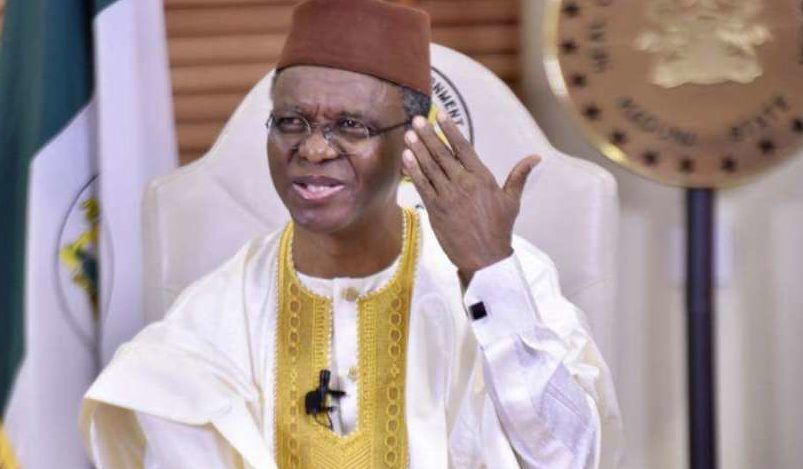
Detained former governor of Kaduna State, Nasir El-Rufai, on Wednesday made a U-turn in his claims that the telephone conversations of Mallam Nuhu Ribadu, the National Security Adviser, NSA, were tapped.
El-rufai, who declared that his remark was not factual, said it was a political rhetoric meant to make those in government uncomfortable.
The former governor spoke when he opened his defence before Justice Joyce Abdulmalik of the Federal High Court in Abuja in the ongoing case filed against him by the Department of State Services, DSS.
El-Rufai, in an interview on Arise Television on February 13, claimed he knew that the government placed surveillance on leading opposition figures, past presidents, senior judges, among others.
The ex-governor, who accused Ribadu of ordering his attempted arrest, said he knew about the directive because they had listened to a telephone conversation in which the NSA instructed security operatives to arrest him.
When asked how he obtained the information during the interview, El-Rufai replied, “He made the call because we listen to their calls.”
He, however, acknowledged that intercepting telephone conversations without authorisation was illegal.
Led in evidence on Wednesday by his lawyer, Paul Erokoro, SAN, El-Rufai stated that he elected to claim that someone tapped Ribadu’s phone to create the impression that the opposition figures were equally monitoring those in government.
While El-Rufai was giving his testimony, Erokoro at a point sought the court order to have part of the recorded interview he granted to the television station played in open court.
After listening to the portion of the interview, Erokoro asked El-rufai to clarify what he actually meant by the statement, following which El-rufai admitted claiming that they were listening to the NSA and others’ conversations and that someone tapped Ribadu’s phone and relayed his conversations to them.
He, however, said he did not intend the statements to be taken in their literal sense, claiming that they were intended in “the context of literal flourish and in rhetorical form,” adding that it was political rhetoric that is allowed in political speaking.
El-rufai said: “What I wanted to say was that the government was monitoring opposition figures and that we knew what they were doing.
“I used the word ‘tap’ as political rhetoric to make them uncomfortable. It was rhetorical, not literal. It was linguistic flourish, just to make the government uncomfortable.”
When reminded by Erokoro that his interviewer told him that it was illegal to tap someone’s phone, he said his intention was to make it public that the government was secretly listening to opposition figures’ conversations without lawful court orders.
He said, “I was referring to the government violating the law and not someone else doing it.”
On who he referred to as “we” in his claim that “we are listening to their conversations…” the ex-governor said he meant himself and other leading opposition figures.
He said he and others did not tap Ribadu’s phone, but learnt about his plan to abduct him and have him detained through a mutual friend.
He refused to disclose the identity of the said friend on the grounds that he would not want to jeopardise the interest of his source.
The ex-governor said when he got home after the interview, the said friend came to him and said he actually did not tap the NSA’s phone, and that he responded by telling the person that he knew, but only chose to make the claim to make those in government uncomfortable.
Earlier, he told the court that he knew Ribadu since 2003 when he, as the head of the Bureau of Public Enterprises, BPE, assisted him to establish the EFCC by providing office space and funds.
El-rufai said the break down in their relationship came when he (Ribadu) ran for the presidency in 2011 and he felt Buhari was a better candidate.
He claimed that the NSA was against him because he was opposed to President Bola Tinubu’s re-election.
The ex-governor denied being involved in phone tapping, adding that he neither have the knowledge or equipment to intercept phone calls.
Under cross examination by prosecuting lawyer, Oluwole Aladedoye, SAN, El-rufai, who claimed he had a degree in Law from the University of London, said he had chosen not to tell the court the names of those he referred to as “we” in his claim that they were listening to the conversations of those in government.
He also declined to give the name of the person, who he claimed, told him that the NSA, Governor Uba Sani of Karuna State and the chairman of the Independent Corrupt Practices and other related offences Commission, ICPC, held a meeting and agreed to ensure his arrest.
The ex-governor said he knew of the alleged plan to arrest him before he arrived from Cairo on February 12, adding that he resisted the attempt by operatives of the DSS to arrest him at the airport when he arrived from Cairo because they did not produce a valid arrest warrant.
El-rufai said his claims, in the same television interview, that he had never stolen public funds and that he knew nothing about the disappearance of an activist, Dadiyatta while he was governor of Kaduna State were factual and true.
He said all other claims he made in the interview were true and factual except the one relating to the tapping of Ribadu’s phone.
The ex-governor, who claimed he filed fundamental rights suits over the alleged search of his house with defective warrant, however admitted that the cases had all been dismissed by the High Court of the Federal Capital Territory, FCT, and the Federal High Court.
While rounding off his cross-examination of the defendant, Aladedoye told the court that Erokoro approached him before the commencement of proceedings for his assistance in the defence’s plan to invite Ribadu and the ICPC Chairman as its witnesses.
Aladedoye said he told the defence lawyer that he could not assist in that regard because it was not within his control.
Erokoro, however, said he would make the necessary applications in that regard, following which Justice Abdulmalik adjourned the matter untill February 15 and 16 for El-rufai to continue his defence.
Source: NAN
READ ALSO:
Atiku at 80: Tinubu rejoices with former vice president
Clashes: C’River imposes dusk-to-dawn curfew on communities
NDLEA dismantles another industrial meth lab in Enugu
Tinubu arrives in Maiduguri, inaugurates projects
EndSARS: Coroner orders release of Journalist Onifade’s remains
EXTRA: Between hope and certainty, By Tunde Busari
‘Ebube Dike,’ Nigeria has lost one of its greatest thespians
APC mourns victims of fatal road accident in Zamfara
EXTRA: Between hope and certainty, By Tunde Busari
Nine books, one defiant voice: Reviewing a literary journalist
Experience of a smartphone addict in a repair shop
My mother: So long an absence!
FirstBank unveils enhanced LIT App and launches ‘Make It LIT’ campaign
FIFA appoints Bashiru as member of NFF Normalisation Committee
Sarafa Isola at 66: Abiodun celebrates former UK High Commissioner