

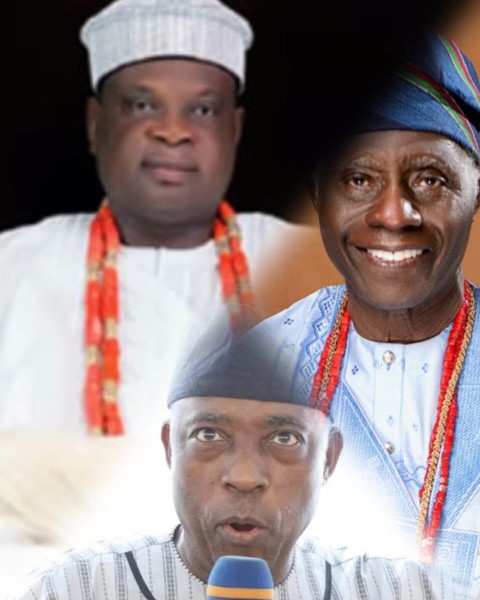
The Yoruba traditional institution may be heading towards a dangerous precipice unless urgent measures are taken to halt the proliferation of monarchs, restore standards of royal conduct and protect the integrity of ancestral stools, the Olota of Ota, Oba (Prof.) Adeyemi Obalanlege, has warned.
The monarch, who painted a grim picture of what he described as a deteriorating institution, called on governments and traditional rulers across Yorubaland to declare a state of emergency to arrest the growing crisis.
He spoke on Sunday night during the 49th edition of Boiling Point Arena, a hybrid media discourse platform, which examined the theme: “Yoruba Obas, Cultural Desecration and the Crisis of Royal Authority: The Dividing Line Between Cultural Change and Cultural Disrespect.”
The discourse featured veteran journalist and author, Dare Babarinsa; Egba High Chief and businessman, Chief Bode Mustapha; and the Olota, who joined the conversation with a blistering assessment of the state of traditional rulership.
Obalanlege lamented that individuals with questionable backgrounds, including alleged land grabbers, were increasingly finding their way onto traditional thrones, thereby undermining the respect and confidence that the institution ought to command.
“When you see dubious people, land grabbers being made monarchs, how could people or their subjects respect the institution? There wouldn’t be any respect again,” he declared.
The discourse hosted by a veteran journalist and public relations strategist, Ayo Arowojolu, was transmitted via Zoom and broadcast live on seven partner radio stations across the country.
The Olota blamed both politicians and sections of the traditional institution for the crisis, accusing political authorities of elevating unsuitable individuals and creating what he described as unnecessary traditional stools.
He argued that monarchs, who should ordinarily deploy cultural wisdom and moral authority to counsel their people and promote peace, were increasingly becoming part of the problem they were expected to solve.
“Obas are supposed to set examples. They are supposed to use our culture to counsel. But nowadays, they are the ones destroying the culture,” he said.
The monarch expressed concern that the institution was being reduced to a spectacle, citing instances of individuals claiming royal status outside Nigeria without clearly established traditional territories.
He warned that unless traditional rulers themselves insisted on standards and governments stopped compromising the institution, Yorubaland risked losing the traditional authority that had historically helped sustain its cultural identity and communal order.
Among his recommendations was the introduction of periodic training for monarchs, arguing that traditional rulers needed continuous orientation to understand the responsibilities and expectations attached to their offices.
For his part, Chief Dare Babarinsa, however, brought a historical and institutional perspective to the debate, tracing some of the present-day tensions to the evolution of Yoruba kingship, disputes over precedence and the gradual expansion of the number of people bearing the title of Oba.
He explained that Yoruba traditional rulership had historically been associated with the Oduduwa lineage, while other forms of community leadership operated under titles such as Olu and Baale.
But over the decades, the distinction became increasingly blurred as communities and their leaders sought greater recognition and prestige.
Babarinsa recalled that the Western Region House of Chiefs once had about 30 traditional rulers representing the region, whereas the number of monarchs in individual Yoruba states had since grown considerably.
He argued that the proliferation of Oba had created a situation in which traditional rulers themselves must urgently determine how the institution should be organised and how distinctions in status and precedence should be maintained.
“Too much of everything is bad,” he observed, warning that the uncontrolled expansion of royal titles had weakened the institution’s collective standing.
He also traced the weakening of traditional discipline to the abandonment or dilution of established practices, particularly the Ipebi institution, where prospective monarchs were traditionally secluded, trained and prepared for the responsibilities of kingship.
According to him, Ipebi was not merely a ceremonial stage of enthronement but an important process through which a prospective Oba acquired the cultural and traditional orientation required of the office.
Babarinsa also recalled the traditional restrictions surrounding royal appearance and conduct, including the significance attached to the royal crown and the prohibition against removing it casually in public.
While supporting the need for traditional rulers to meet and fashion out a common position, he differed somewhat from the suggestion that they should be given additional constitutional powers.
He maintained that the strength of traditional rulers lies principally in their influence and moral authority rather than in the exercise of governmental power.
“Anybody who is close to traditional laws will know that they are very, very busy people. Their position is a position of influence, not of power,” he said.
Babarinsa cautioned that when traditional rulers struggle for political power with elected office holders, they often emerge weakened.
Rather than becoming embroiled in political contests, he urged monarchs to deploy their influence to promote development, preserve cultural values and strengthen their communities.
He nevertheless supported the need for traditional rulers to resume regular meetings and establish a code of conduct capable of preventing conduct that brings the institution into disrepute.
Babarinsa also acknowledged that the traditional institution must accommodate historical and social changes, noting that some important Yoruba towns whose rulers were not originally recognised as Obas in the old order had, over time, acquired such status.
He argued that the challenge was not necessarily the existence of change but the emergence of individuals whose conduct and credentials, in his view, had given the institution cause for embarrassment.
Chief Bode Mustapha, who strongly aligned himself with the Olota’s concerns, was equally unsparing in his criticism of what he described as the growing abuse of traditional titles.
In particularly blunt remarks, he accused some individuals seeking royal titles of being motivated more by opportunities for land acquisition and sale than by any genuine commitment to community development.
“I call them 419 Obas. The moment a few of them are sent to jail, others will sit tight,” Mustapha declared, advocating firm legal consequences for monarchs found culpable of land grabbing and other offences.
He lamented that some traditional rulers allegedly operated outside their domains, lacked palaces in the communities they claimed to govern and awarded chieftaincy titles at venues far removed from their traditional territories.
According to him, the original intention behind the creation of additional traditional leadership structures in developing communities was to promote grassroots development and extend the benefits of urbanisation.
However, he argued that the process had been abused by individuals whose ambitions were allegedly driven by personal interests.
Mustapha also recalled an occasion in Abeokuta when about 75 individuals were reportedly paraded as monarchs, with some leaving the venue on commercial motorcycles while struggling to keep their crowns on their heads.
He described such spectacles as an embarrassment to an institution whose dignity was traditionally reflected in the comportment, restraint and public conduct of its occupants.
The Egba high chief also criticised the growing influence of partisan political considerations in the creation and elevation of traditional stools, insisting that royal appointments should not become rewards for political loyalty.
He called for a constitutional amendment to clearly define the roles and status of traditional rulers, particularly in the South-West, arguing that their proximity to grassroots communities makes them important partners in governance and information dissemination.
In one of the most concrete proposals at the discourse, Mustapha suggested that state governments should establish commissions of inquiry to investigate how some of the existing traditional stools were created and how their occupants emerged.
He said such an exercise should establish clear parameters for recognising traditional rulership, including the population of a community, the existence of a genuine constituency, and the availability of basic social infrastructure.
He questioned the rationale behind elevating individuals to prominent royal positions in communities with very few inhabitants and little evidence of a properly established traditional domain.
“Unless and until something is done about that, we will still continue to have this proliferation,” he warned.
Mustapha further endorsed the idea of a peer-review mechanism among traditional rulers, arguing that the institution needed an internal process capable of checking excesses and restoring discipline.
Despite differences in their prescriptions, the three speakers converged on the need for urgent corrective measures, with particular emphasis on the role of traditional rulers themselves in restoring the institution’s credibility.
Mustapha advocated constitutional safeguards and government intervention, while Babarinsa warned against turning traditional rulers into political power brokers.
The Olota, meanwhile, insisted on periodic training and a collective determination by monarchs to defend the standards of the institution.
The question of how traditional rulers emerge also featured prominently, with Mustapha arguing that the process required a thorough review and Babarinsa insisting that monarchs should take responsibility for defining their own institutional distinctions.
On the integrity of succession processes, Mustapha urged a return to the traditional role of Ifa in selecting suitable candidates, arguing that the emergence of the right person could help guarantee peace and stability in a community.
“If we can go back to Ifa, to the oracle, let the oracle speak,” he said, adding that the selection of unsuitable individuals could create problems for both the monarch and the community.
Babarinsa also called for a code of conduct for Yoruba monarchs, stressing that the traditional ruler should serve all members of the community irrespective of religious affiliation.
He warned that the public could do little to prevent politically motivated appointments unless the traditional institution developed an effective internal mechanism for regulating itself.
The 49th edition of Boiling Point Arena thus exposed a troubling contradiction: an institution historically revered as a custodian of Yoruba identity and communal values is now facing questions about the conduct of some of its occupants, the integrity of appointments and the political forces shaping its evolution.