

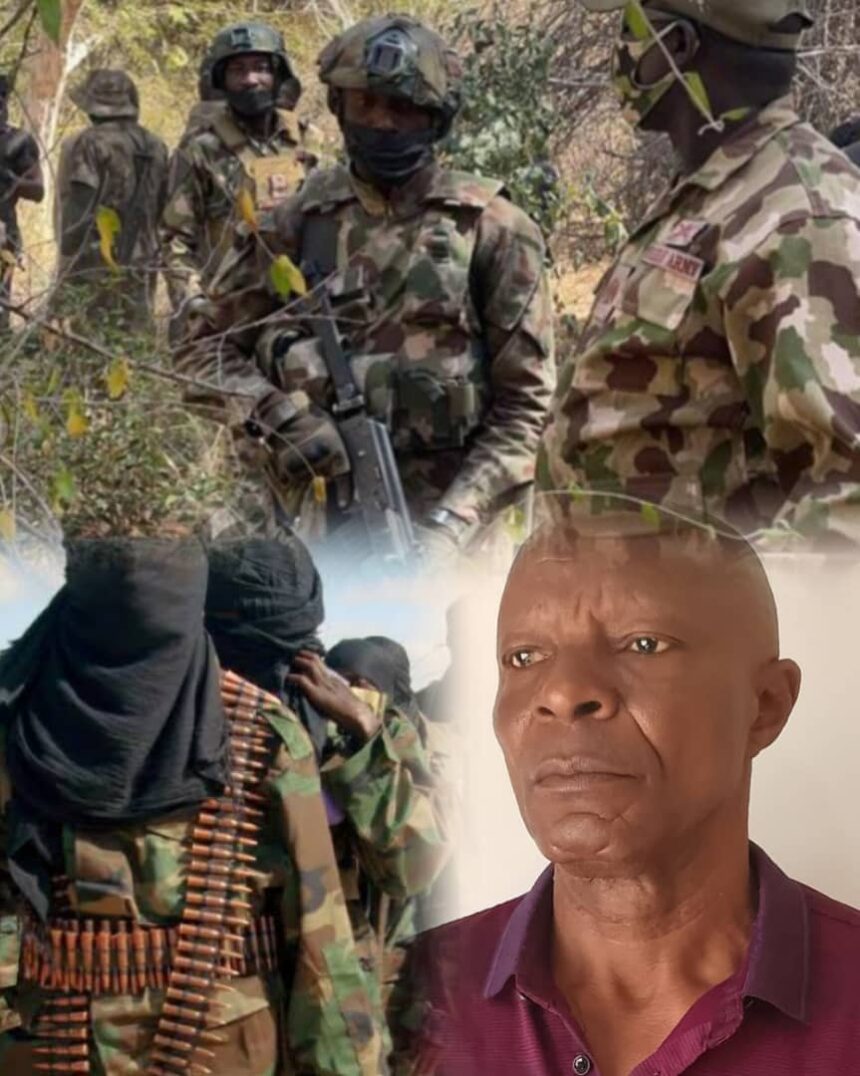


A retired Colonel and security strategist, Lawrence Owosheni, has blamed Nigeria’s prolonged battle against terrorism, banditry and school kidnappings on what he described as an obsolete counter-insurgency architecture.
He warned that the country could not win a modern war with outdated military structures.
Owosheni argued that after nearly 16 years of sustained counter-insurgency operations, the nation’s security strategy had failed to deliver meaningful results because it remained largely analogue and excessively dependent on conventional command systems rather than technology, intelligence and real-time communication.
The retired military officer spoke during the maiden edition of Boiling Point Extra, a public affairs discourse devoted to finding lasting solutions to Nigeria’s worsening insecurity.
The topic was “School Kidnappings: Securing the Classrooms and Safety of Children in Nigeria.”
According to him, the Nigerian Armed Forces possess the capacity to defeat criminal groups, but require a complete restructuring of the country’s counter-insurgency command architecture.
“Nigeria’s machine of war remains predominantly analogue,” he declared.
Owosheni lamented that while leading military powers across the world had embraced information superiority, artificial intelligence, surveillance technology and integrated communication systems as the backbone of modern warfare, Nigeria continued to rely on structures designed for conventional warfare.
He said: “Intelligence and communication—not hitherto command and discipline—is now the heart of armed forces.”
According to him, this explains why insurgents, terrorists and bandits continue to exploit gaps within Nigeria’s security architecture despite years of military operations.
The retired Colonel therefore proposed the establishment of a Joint Military-Civil Sector Counter-Insurgency Operations Command Structure, stretching from the national headquarters down to every geopolitical zone, state and local government area.
Under the model, representatives of the military, police, intelligence agencies, immigration, customs, correctional service, civil defence, traditional institutions and community organisations would operate from integrated situation rooms linked through satellite communication and digital technology for real-time intelligence gathering, analysis and coordinated response.
He explained that such a structure would ensure criminals could no longer move across local governments or state boundaries without being detected and intercepted.
“No kidnappers, bandits or terrorist groups should be able to move across LGAs, states or zones without being seen, crushed and annihilated by the counter-insurgency force,” he said.
Owosheni maintained that counter-insurgency operations should be driven primarily by credible intelligence supplied through communities and supported by modern surveillance technologies including drones, satellite imagery and reconnaissance systems rather than depending almost exclusively on kinetic military operations.
He equally faulted what he described as the military’s increasing involvement in non-core responsibilities, insisting that soldiers should remain focused on their primary mission of defeating insurgents while political leaders address the root causes of insecurity.
The retired officer also linked the rising wave of school kidnappings to Nigeria’s broader national security failures, arguing that protecting schools could not be separated from securing the entire country.
He warned that treating school abductions as isolated incidents merely trivialised the wider security crisis confronting Nigeria.
According to him, the responsibility for safeguarding children ultimately rests on an integrated national security framework involving governments, communities, schools, parents and security agencies working collaboratively.
Owosheni further advocated community policing, stronger intelligence sharing and greater collaboration between schools and law enforcement agencies as immediate measures to reduce school kidnappings while broader reforms are implemented.
He concluded by urging the federal government to urgently abandon what he called the country’s obsolete counter-insurgency strategy and replace it with a technology-driven, intelligence-led command system capable of responding proactively to emerging security threats.
“The Nigerian State and indeed her military should change strategy… without further delay,” he urged.
The programme, Boiling Point Extra, hosted by a veteran broadcaster, Ayo Arowojolu, was transmitted via Zoom and broadcast live on multiple partner radio stations across Lagos, Ogun and Delta states.
The discourse was held in collaboration with the National Association of Seadogs(NAS) and also featured other discussants like Col. Lawrence Owosheni(rtd), Assistant Commandant-General, Nigeria Security and Civil Defence Corps, Mrs Rachael Awosusi(rtd), Strategy and Development Expert, Mr Yinka Quadri and Veteran Journalist, Mr Yemi Akuntunde.
READ ALSO:
W’Cup: Colombia secure 1-0 win over Ghana to reach Round of 16
Osun election: I-G orders crackdown on criminals
Equities market rebounds with N3.16trn gain
W’Cup: Egypt triumph 4-2 on penalties after 1-1 draw with Australia
APC state chairmen meet in Lagos, strategise ahead of 2027
Navy discovers illegal fuel storage site, recovers 18,000ltrs of AGO
NSCDC arrests two suspects over alleged job racketeering in Oyo
Ogun guber: US-based Bolaji Odusina wins NDC ticket
WorldStage: How to build world class corporate culture –Baale
Oriire abduction: No ransom paid to kidnappers -Oyo govt
FOR THE RECORD: Democracy is stymied without free press
Chams founder, Demola Aladekomo, to chair QEDNG Creative Powerhouse Summit 2.0