
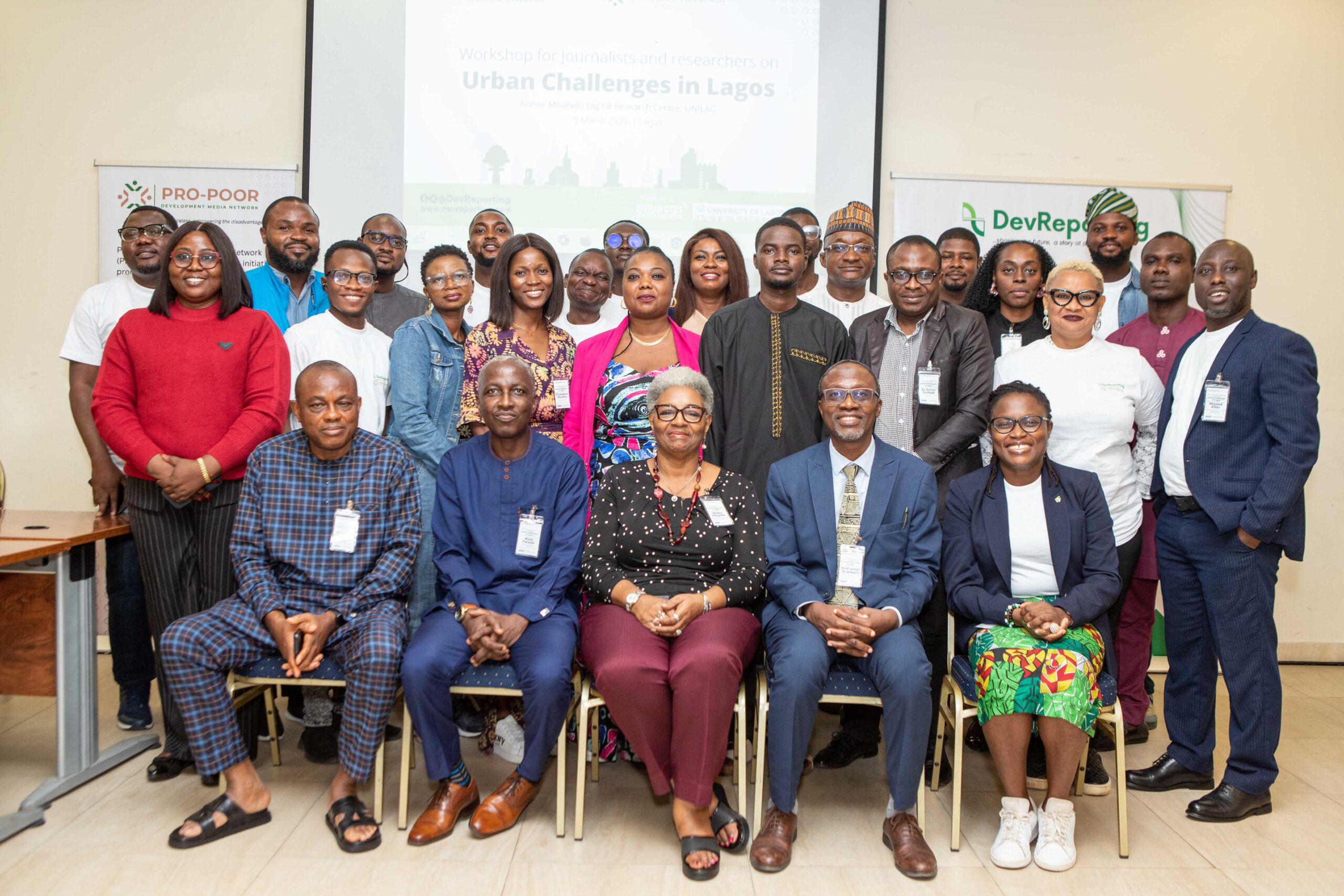
A capacity-building workshop organised by DevReporting has brought journalists and researchers together in Lagos to strengthen development reporting on urban challenges and close the long-standing gap between the two professional fields.
The workshop, held Thursday at the Arthur Mbanefo Digital Research Centre of the University of Lagos, is part of an urban reporting project supported by the African Cities Research Consortium (ACRC).
Speaking at the event, DevReporting Team Lead, Mojeed Alabi, said the relationship between journalists and researchers has often been strained, with both sides sometimes viewing each other as ego-driven.
Mr Alabi said the disconnect had limited journalists’ access to credible research evidence while also denying researchers the wider public platform journalism provides.
He recalled a 2023 engagement in Tanzania where similar concerns were raised about the divide between researchers and journalists, stressing that development required deliberate collaboration.
According to Mr Alabi, action research can only translate into meaningful change when journalists and researchers work together.
“The currency spent on action research for development journalism is collaboration, and that is what has made this initiative possible,” he said.
Media partnership essential for inclusive city development
The Director of Uptake of ACRC, Ismail Ibraheem, a professor, said the consortium worked across African cities to understand how urban systems functioned and how they influenced development outcomes.
According to him, ACRC research examines the interconnected systems that determine how cities operate.
“We cannot understand how the city works without understanding its configuration in terms of government, transportation, education, health and other sectors,” Mr Ibraheem stated.
According to him, ACRC research across cities, including Lagos, shows that meaningful development depends on factors such as elite commitment, reform coalitions, organised communities and strong state capacity.
He emphasised that the media played a critical role in driving elite accountability and ensuring that research findings translated to public action.
Similarly, ACRC Lagos City Manager, Temilade Sesan, also stressed the need for stronger collaboration between journalists and researchers, noting that both groups shared a common goal of improving the lives of people in marginalised communities.
She recounted how a chance meeting with an editor and resource person, Ogechi Ekeanyanwu, at an airport helped amplify her research work and brought greater attention to the communities affected by the issues she studied.
According to Mrs Sesan, the experience demonstrated how partnerships between researchers and journalists can catalyse social change.
In a goodwill message delivered virtually, ACRC Communications and Impact Manager, Chris Jordan, said marginalised African communities needed the media now more than ever.
He urged journalists to focus on human-centred stories that highlight the realities of people living in underserved areas.
Mr Jordan added that journalists had unique access to communities and could translate research insights into compelling narratives that reached the public more effectively than academic publications.
“We have always seen our relationship with the media as crucial. The media does it better than we can do it ourselves. You can access insights from people and give engaging stories to the public and communities. We look forward to seeing what you journalists produce on this project and see how we can utilise it,” Mr Jordan said.
Insights from ACRC action researches
During the workshop, Leverhulme Professor of Planning and Heritage at the University of Liverpool, Taibat Lawanson, presented findings from the foundation phase of the ACRC project, which began in 2022.
She explained that researchers examined nine major systems that determine how cities function. These include water supply, sanitation, transportation, health, education and energy, alongside food distribution, finance and digital connectivity.
Mrs Lawanson said the research found significant gaps in access to essential services, particularly for residents living in informal settlements.
According to her, proximity to formal systems often determine access to essential services, leaving many urban residents underserved.
She noted that although the Lagos State Government provided about 40 per cent of the state’s daily water supply capacity, only about 30 per cent of residents at that moment had access to public water systems, highlighting major infrastructure and governance challenges.
Critical urban challenges such as water supply, sanitation and waste management also featured prominently during the workshop, with researchers presenting findings from community-based projects in Lagos.
Presenting ACRC’s Water, Sanitation and Hygiene (WASH) action research project, Co-lead of the WASH Project, Oluwaseun Muraina, said the initiative focused on improving access to clean water and sanitation in Okerube, one of the largest informal settlements in Alimosho Local Government Area of Lagos State.
Ms Muraina explained that the project adopted a community and gender-led approach that placed women at the centre of governance and decision-making on water and sanitation infrastructure.
According to her, the project integrates governance reforms, gender inclusion and community participation to create sustainable solutions.
She noted that women-led water committees had obtained the commitment of the local ward councillor, leading to the transfer of two boreholes to the committee for management, however, provisions were not made for proper management, hence, limiting sustainability.
On his part, the Team Lead for ACRC’s Waste Management project, Deji Akinpelu, shared the waste management challenges. He said poor waste disposal practices are closely linked to recurring flooding in several parts of the state.
He explained that when waste collection systems failed, residents often dump refuse in nearby canals and drainage channels, blocking waterways and increasing the risk of flooding during heavy rainfall.
Telling compelling stories, communicating research for impact
Veteran broadcaster and Co-Chair of the Pro-Poor Development Media Network, Bimbo Oloyede, urged journalists to produce stories that not only inform the public but also drive action.
She advised journalists to focus on clarity, connection and memorable storytelling while highlighting the human impact of urban problems.
According to her, development reporting should make complex issues relatable and motivate stakeholders to respond.
“There’s no point sharing your story and no one does anything about it. You must write in a way that people understand and are willing to do something about it,” Mrs Oloyede said.
“Urban areas have big issues. Sometimes, the problems can be overwhelming, so we can micro the macro in our reports. Zoom in on who is affected, what the citizens can do, and who is responsible,” she added.
The Commissioning Editor of The Conversation Africa, Wale Fatade, noted that many research studies conducted in Nigeria remained underutilised because researchers often struggled to communicate their findings beyond academic circles.
He encouraged journalists to convert research outputs into formats such as news analysis, features, question-and-answer pieces and podcasts. He also urged journalists to avoid jargon, acronyms and overly technical language, advising them instead to explain complex ideas in clear and simple terms that ordinary readers can understand.
“You should focus on the key story behind the research, apply the basic principles of the five W’s and H, and explain complex ideas in a way that can be understood by a general audience,” Mr Fatade said.
From field to workshop
Senior journalists at the workshop also shared their field experiences reporting urban challenges.
A Correspondent for Thomson Reuters Foundation, who is a mentor on the project, Bukola Adebayo, addressed the challenge of rehashed narratives, particularly around demolitions and evictions. She advocated multimedia storytelling, following a single family, documenting a day in their life through video and photography, to create a visceral connection with audiences.
“Photography is extremely important. Multimedia speaks to the audience more than text ever can,” she stressed.
Similarly, the Weekend Editor, Guardian Newspaper, who is also a mentor on the project, Kabir Garba, cautioned against the use of outdated, recycled data, urging reporters to investigate why data remained static.
“If you are reporting on out-of-school children, don’t just give me the numbers. Ask why those numbers haven’t changed in ten years. Ask what is being done, who is blocking progress, and what accountability looks like.”
The Regional Coordinator, Sub-Saharan Africa of SciDev.Net, Ogechi Ekeanyanwu, urged journalists to engage researchers directly, ask critical questions and prioritise human-interest angles in their coverage of development issues.
Drawing on decades of experience, the Managing Editor of Guardian Newspaper, Chinedum Uwaegbulam, took participants on stakeholder mapping. Using the Lagos context as a case study, he illustrated how a simple story like “Flood hits Lekki” can be transformed into an investigative piece by using a map to ask questions such as: Which institutions failed? Who approved the development? Who ignored the early warnings? Who funded it? Who benefited? Who suffered?
Initiative provides story support to journalists
The collaboration between DevReporting, the Pro-Poor Development Media (PDM) Network and the African Cities Research Consortium is expected to generate impactful stories that draw attention to urban challenges and encourage policy action.
Mr Alabi stated that the journalists had four weeks to deliver impactful reports, with mentorship, editorial and research support provided under the project. He urged them to reach out to the researchers or the DevReporting project management for additional support that would help them deliver adequately.
READ ALSO:
The accountability of thought: A debt I owe Chris Asoluka
Violence hits Wike’s faction at PDP Oyo congress
Kara Bridge: FG to begin repair work Tuesday, advises motorists
The road to Oke Mosan is paved with broken promises
Beyond rhetoric and photo ops: The undervaluation of Women’s Day
FCT: Troops rescue 19 kidnap victims, neutralise terrorists
WEATHER FORECAST: NiMET predicts hazy condition
Iyabo Obasanjo and the feeble defence of constituency neglect
Trump demands ‘unconditional surrender’ as Iran war enters second week
Troops rescue 12 kidnap victims, nab suspects in Enugu
Police arrest suspected kidnappers, cultists, others in Kwara