

My most pleasant visit to Kenya occurred last week because it was the first visa-free visit. I am so happy that President Ruto gave unequivocal expression to a concern he had raised in a video I saw two years ago where he bemoaned why an African should require a visa to visit any African country. As I write, save for Libya and Somalia (and mainly due to security concerns), Africans are at liberty to go to Kenya – not to get visa on arrival – VISA FREE.
“Good morning, Professor, what brought you to Kenya this time?”, the courteous, beautiful lady immigration officer enquired from me as she requested my passport at Jomo Kenyatta International Airport. I responded verbally, proceeding to discharge the burden of proof with the missive from PRSK. “Welcome to Kenya”, the lady stated with a pleasant smile and tonality as she stamped my passport and handed it over to me. Her paralanguage was fantastic. It synergised the spoken word. It was authentic.
I completed my obligations with PRSK at Eldoret City – otherwise called ‘The City of Champions’, a befitting moniker since Kenya’s leading marathoners and sprinters peopled the city – I was chauffeured to Kisumu. Eldoret City in Uasin Gishu County in Western Kenya, one of Kenya’s 47 Counties, was designated Kenya’s 5th city recently and it is the country’s fastest growing city. Other cities are Nairobi, Mombasa, Kisumu and Nakuru, which like Eldoret is also in Rift Valley Region. In Kenya, you do not just name a community a city, it is the prerogative of the government of the Republic to designate a space as a city because there are criteria to be met before a community can be so characterised. Broadly multicultural and multiethnic – you would find Kalenjins, Luhyas, Kikuyus, and others in Eldoret, a name that came with its own controversy, perhaps a typographical error, though ‘eldore’, is a Maasai word for ‘Stony River’.
The peerless Canadian communication scholar, Marshall McLuhan, had also embraced an error, converting it to strength. He had sent his classic book, with the title, “The Medium is the Message: An Inventory of Effects” to the printer, only for the product to come back with a typographical blunder, the error ‘Massage’ instead of ‘Message’, was right on the title. An uncanny thinker and philosopher, McLuhan adopted the ‘erroneous title’ reckoning that it made sense. So, is the story of Eldoret. “These things happened”, says Professor Kingsley Ologe, a father and mentor, in his book, “Help from Above: The Travails and Triumph of a Child of God”, where in the first chapter he recalled a ‘descent into anomie’ at the University of Abuja where he was Dean of Faculty of Social Sciences. I was involved but that is a story for the future. However, things do happen, even to the title of this travelogue. I was chatting with my friend and brother, Simbo Olorunfemi, while on the road to Kisumu and he picked the phrase, ‘On the road to Kisumu’ from a note I had sent to him, stating that it “Reads like the title of a book.” As I reflected on this script, I was glad Simbo took off my shoulders the probative burden of looking for a title for my piece.
But it was more gratifying to see Nigerians winning in the Africa; and South Asia and Middle East sessions of SYPM conference 2025. Congratulations to all African winners and to Aromaradu Salahudeen Salihu, Azeez Sulaiman, Ikwuorgu Favour Eloho and Ogunsemowo Moyinoluwa Elizabeth for making Nigeria proud in the 2025 #NextInLine Hero Web Conference with the theme, “From Hashtags to Headlines: How Communication Can Change the World in the AI Era”.
I could have returned to Nairobi from Eldoret to connect a flight to Addis Ababa the way I came into Kenya but things happen. So, PRSK got me a driver to take me to Kisumu International Airport to take a late evening flight to Nairobi. I set out early arriving at Kisumu before 3.00pm to enable me to chair and moderate a web conference commemorating the Student and Young Professional Month organised annually by the Global Alliance for Public Relations and Communication Management (GA). I was banking on the free public Wi-Fi at the airport for connection because I knew all airports in Kenya had robust free Wi-Fi. I made it to Kisumu on time and the airport free Internet connectivity was excellent.
But while on the road to Kisumu, a two- and half-hour drive, the man at the steering became an interesting interlocutor. A graduate of environmental sciences from Moi University – an institution named after Daniel Arap Moi, Kenya’s second president. Kenya has had only five presidents since 1963 when it earned her political independence. So, our conversation started from my driver’s alma mater. “Professor, you seem to know a lot about Kenya from the way you spoke about Moi”, the driver said to me. I responded by correcting him. “I am not a professor”. “Are you a doctor, because you look like an academic?” he asked waiting enthusiastically for me to answer in the affirmative. “Yes, I am doctor”, I responded. “Ooh, Daktari”, he resounded in Swahili.
Then we started a discourse on Africa. I listened to him patiently before responding to his questions. The first knowledge-sharing session was on growth and development. We made lots of comparison between Nigeria and Kenya and I told him the difference between growth and development. Using Kenya and Nigeria as examples, I spoke to theories, beginning with WW Rostow, a former national security adviser to the US president, who was succeeded by Henry Alfred Kissinger.
I told my man that Rostow’s linear theory of stages of growth and development was fundamentally flawed and cited Paul Baran, AG Frank and others. With empirical and experiential evidence, I told my man that growth is not synonymous with development and GDP is also not an index of development, though it may be an indicator of volume of production, largeness of market and national (not individual) prosperity, and I introduced him to the works of Amartya Sen after I had juxtaposed statistics about Nigeria and Kenya in five different sectors. He could visualise the strengths, challenges and prospect of both countries especially in the context of ongoing reforms.
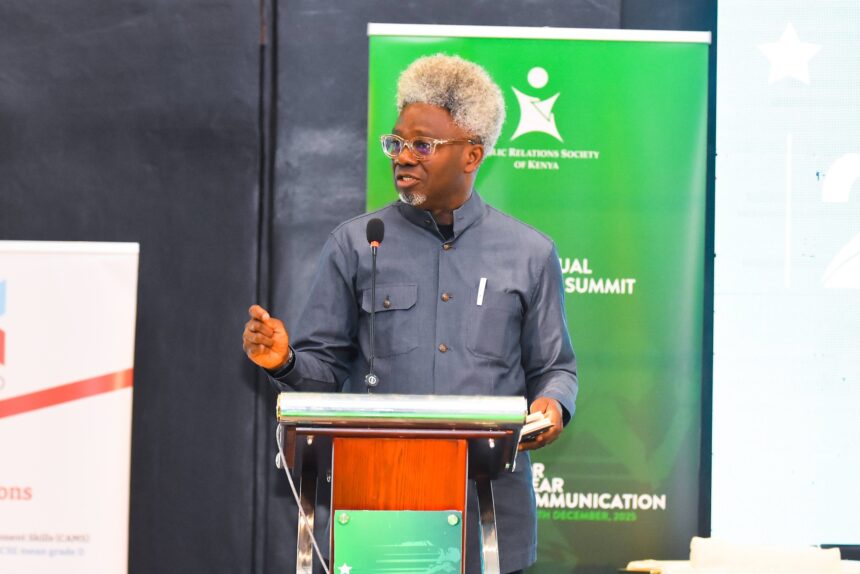
From there we migrated to discuss why I was in Kenya. So, I spoke about APRA, my role in its upturn and why we feel Africans should reimagine the future of communication, especially governmental and executive communication in the era of AI, and particular why need to focus on clear, concise and compelling communication. My man and I agreed that whether it is about security of lives and property, investing in government securities and bonds, or leveraging reforms, communication is at the heart of human success. I spoke about miscommunication in Africa and globally and I gave him examples of its manifestation like poor communication, wrong communication, late communication and incomplete communication, pointing out how the last two have been major challenges in governmental communication and thus affecting the fortunes of Africa.
I told my interlocutor that we need to focus on the truth and I spoke to why APRA insists the communication professional is central to the resolution of all crises. On African crisis, I recalled our resolutions at the summit, including the need to love our countries more than we hate our leaders but I also noted our concerns about leadership and admonishing our leaders to be clear, empathetic and accountable.
At Eldoret, we also agreed on the significance of equity, diversity and inclusion as well as timeliness in communication; and the need to have informed stakeholder mainstreaming, ensuring a balance out as we deepen our use of digital media so that no one is left behind – we must reach the hard-to-reach and do so as an obligation. I told my man that one of the messages from Eldoret Summit is the need for communications people to read more so they can spot inaccuracies in what AI gives them because knowledge, emotional, ethical and cultural intelligences will help the human agency to humanise whatever AI tools offer them.
I spoke to my man about earned media and noted that because up to 90 per cent of AI visibility of humans and organisations are driven by citations, we need to optimise earned media, including seeing earned media as a beginning rather than an end. Many communication managers and organisations are too dependent on paid influencers but the masterstroke is to ensure that team leads in digital communication empowers their colleagues to boost even content which influencers have been paid to diffuse. Boost your content for owned and scalable reach.
Increasingly, people are getting answers they need from searches without clicking websites. This is zero click. People rarely get down to see Google highlights and Google has adapted quickly with OpenAI and other tools, indicating a transition from Search Engine Optimisation to Generative Engine Optimisation. I shared with my driver the fact that 60 per cent of search results comes from GEO. This insight should lead us to review strategy for greater value. In addition, while the future may show preference for visuals, AI is more on language and not more on video. It will be nice to do enough textual description on videos to enable AI to access such information. AI has become a new media on its own, so communicators need to publish more frequently and we must commit ourselves irrevocably to measurement and evaluation of work done. It helps you to discharge the burden of proof that you deserve a seat on the table of C-Suite executives.
There is a whole new landscape of intelligent communication. We need to figure out how to preserve trust since technology can mimic reality. Yes, AI is a companion, an assistant that can help to boost efficiency but the real change for PR is to balance invention, ethics, context. The human agency is the more important partner in the emergent duality of agencies (technology and humans). So, while AI has no emotions and may not be able to reflect the truth always, it can help to detect manipulations and alert us on misinformation but humans remain the firewall principles.
In other words, it was beautiful sharing knowledge with the man chauffeuring me on the road to Kisumu. It was great arriving Kisumu timely and set up promptly to moderate the GA SYPM session. But it was more gratifying to see Nigerians winning in the Africa; and South Asia and Middle East sessions of SYPM conference 2025. Congratulations to all African winners and to Aromaradu Salahudeen Salihu, Azeez Sulaiman, Ikwuorgu Favour Eloho and Ogunsemowo Moyinoluwa Elizabeth for making Nigeria proud in the 2025 #NextInLine Hero Web Conference with the theme, “From Hashtags to Headlines: How Communication Can Change the World in the AI Era”.
READ ALSO:
Why we are laying foundation for digital workforce -Tinubu
FirstBank powers Mainland Laffs 3.0 to light up Lagos
Boiling Point: Discussants to dwell on solutions to problems of varsities
Alleged corruption: EFCC to arraign ex-minister, Chris Ngige, today
Police arrest self-kidnap suspect, two accomplices in Ondo
FIFA rankings: Super Falcons drops to 37th, remain top in Africa
Dangote unveils ₦1trn scholarship scheme for 1.3m students
How terrorists bombed Owo church in 2022, Priest tells court
Lagos Police apprehend 13 over mob attack on officer, debunk claims
Police begin recruitment of 50,000 constables (+How to apply)